
The short answer
AI can help churches with media creation, logo concepts, music brainstorming, newsletter drafts, website updates, video editing, accessibility descriptions, social-media planning, and research organization. It should remain a servant tool under human oversight. For El Roi Digital Ministries, AI should not write a full sermon or claim spiritual authority. Pastors and teachers must continue to wrestle with Scripture prayerfully, listen to their congregations, and discern interpretation through the Holy Spirit.
Why this conversation matters
Artificial intelligence is no longer a distant idea for church leaders. Public opinion and adoption surveys can help describe the conversation, but they do not determine ministry ethics and should not be generalized beyond their stated population, sample, wording, field dates, weighting, and response base.[1] That evidence does not prove that AI is good for every ministry task. It does show why churches need a thoughtful framework instead of silence, hype, or fear.
The central question is not, “Can AI produce words, images, or audio?” It can. The better question is, “Which ministry responsibilities can be assisted by a tool, and which responsibilities belong to human beings before God and the congregation?”
A ministry-centered distinction
AI systems generate likely outputs from patterns in data. They do not pray, love a congregation, bear pastoral responsibility, receive a calling, or participate in the life of a local church. Research on large language models has also shown why fluent output must not be confused with understanding, truth, or reliable judgment.[2]
That distinction gives church leaders a practical boundary:
- Use AI for organization, first drafts, variation, accessibility, and repetitive production work.
- Keep truth claims, pastoral care, spiritual interpretation, public accountability, and final approval with people.
- Treat any output as untrusted until a qualified human checks it.
This boundary is consistent with broader ethical guidance. The Vatican’s Antiqua et Nova note frames AI as a human-made technology that must be directed toward human dignity and the common good rather than treated as a replacement for human intelligence.[4] UNESCO’s guidance for generative AI in education likewise emphasizes human agency, privacy, accountability, and responsible use.[9]
Where AI can genuinely help a church
1. Media and design production
AI can help a media volunteer explore a visual direction for a sermon series, youth event, VBS theme, or ministry campaign. It can create rough logo concepts, color combinations, background textures, thumbnail ideas, and layout variations. The church should then choose, revise, and approve the final design.
The best use is often variation rather than replacement. A volunteer may already know the ministry’s message, audience, and visual identity. AI can help generate five starting directions quickly; a human decides whether any of them serve the ministry faithfully.
Use a review checklist:
- Does the image communicate the event accurately?
- Does it respect the dignity of people shown?
- Does it accidentally imitate another church’s logo or a living artist’s distinctive work?
- Is every person’s likeness used with permission?
- Are there theological symbols that could confuse or misrepresent the church?
2. Music and creative brainstorming
AI can help a worship or media team brainstorm themes, instrumentation, transitions, mood boards, or arrangement possibilities. It can suggest ways to organize a rehearsal or create a list of questions for a composer.
It should not be used to imitate a living artist, copy a copyrighted song, or create a finished worship song that the church presents as though it came from a human songwriter without disclosure. The team must check licensing, ownership, and platform rules before publishing or performing the result.
3. Newsletters and announcements
AI is useful for turning approved facts into several communication formats: a newsletter paragraph, a website announcement, a slide, an email subject line, a social caption, and a short reminder for volunteers. The input should be information the church has already approved.
The human review must confirm dates, locations, names, registration links, childcare details, accessibility information, and any statement that could affect a person’s decision to attend. AI should never invent a testimony, quote a pastor, or add a promise that leadership did not approve.
4. Website maintenance
A church team can use AI to identify unclear headings, rewrite a paragraph in plainer language, draft alt text, convert a long notice into a short visitor guide, or generate a checklist for updating ministries and contact information.
The team should not paste confidential pastoral notes, counseling information, private prayer requests, unreleased personnel information, or personal data into an unapproved service. NIST’s AI Risk Management Framework, together with its Generative AI Profile, is useful here because it treats governance, mapping, measurement, and management as continuing responsibilities rather than a one-time approval.[7–8]
5. Video editing and accessibility
AI-assisted tools can help identify pauses, remove background noise, create captions, produce transcripts, make short clips, and draft descriptions for social posts. These uses can help a small church serve people who cannot attend in person or who benefit from captions and readable summaries.
Human review remains essential. Automatic captions can change biblical names, alter a sentence’s meaning, or misrepresent a speaker. The final video should be checked against the recording, especially when a mistranscription could create embarrassment or theological confusion.
6. Research support for pastors and teachers
AI can help a pastor organize a reading list, identify terms that need checking, compare a few scholarly positions, generate questions for a Bible-study group, or turn approved notes into a research matrix. It can suggest where to look next.
It should not be treated as a commentary, a lexicon, a church historian, or a spiritual director. Every citation must be opened and checked. Every biblical quotation must be compared with a reliable edition. Every historical claim must be traced to a real source.
What AI should not do in El Roi’s ministry framework
It should not write the full sermon
A sermon is not simply an arrangement of religious sentences. It is a pastor or teacher’s prayerful engagement with Scripture and a particular people in a particular place. It carries pastoral responsibility and should arise from the preacher’s own study, conviction, voice, and discernment.
The concern is not only plagiarism or inaccuracy. It is also authenticity: a tool cannot stand before a congregation as the person called to preach, know its wounds, or bear responsibility for the message. This is El Roi’s pastoral boundary, not a claim that a verified 2026 homiletics consensus has been established.
AI may help a pastor locate scholarship, create a source-comparison table, or identify questions that deserve more study. It should not generate a full sermon for the pastor to deliver as if it came from the pastor’s own Spirit-led work.
It should not provide automated pastoral care
Grief, abuse, marriage crisis, confession, addiction, suicidal thinking, and spiritual doubt require human presence and appropriate professional or pastoral care. A church chatbot may help someone find a service time or contact page. It should not pretend to be a pastor or handle confidential spiritual disclosures.
Confidentiality, authenticity, human dignity, transparency, and accountability are prudent pastoral safeguards; this article does not attribute them to an unverified 2026 study.
It should not make decisions about people
Do not use AI to decide who is spiritually mature, which volunteer is trustworthy, who should receive benevolence, or which member is “a problem.” A statistical output is not a substitute for prayerful leadership, due process, or loving conversation.
A simple approval framework
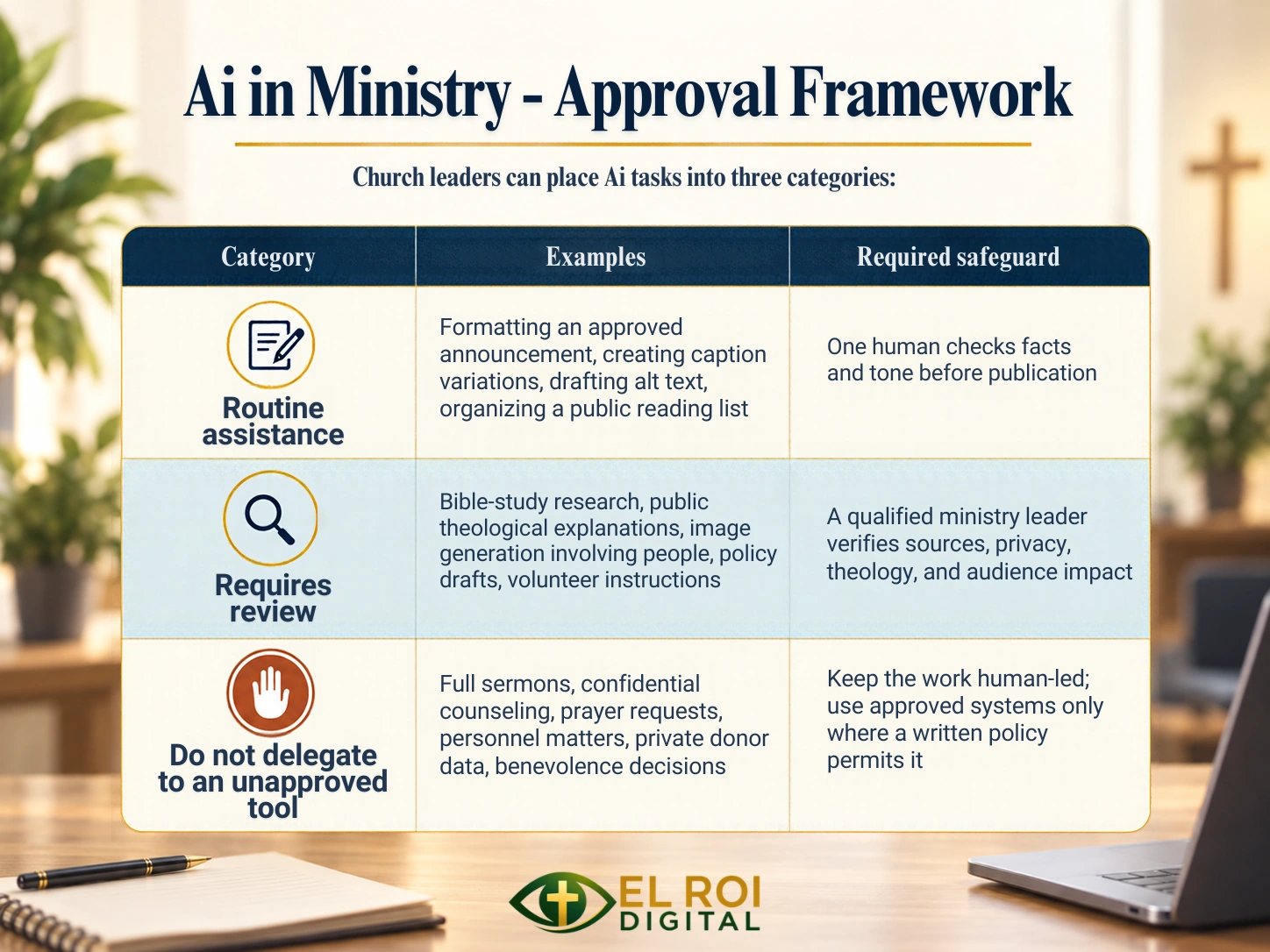
Church leaders can place AI tasks into three categories:
| Category | Examples | Required safeguard |
|---|---|---|
| Routine assistance | Formatting an approved announcement, creating caption variations, drafting alt text, organizing a public reading list | One human checks facts and tone before publication |
| Requires review | Bible-study research, public theological explanations, image generation involving people, policy drafts, volunteer instructions | A qualified ministry leader verifies sources, privacy, theology, and audience impact |
| Do not delegate to an unapproved tool | Full sermons, confidential counseling, prayer requests, personnel matters, private donor data, benevolence decisions | Keep the work human-led; use approved systems only where a written policy permits it |
The middle category requires the most deliberate ministry review; no category should be treated as automatically safe. “Human review” should not mean glancing at the first paragraph. It means identifying who owns the decision, what must be verified, and what would make the output unacceptable.
A practical workflow for small churches
- Start with approved facts, not private stories.
- State the audience and purpose.
- Ask for a draft or set of options, not an unquestioned final answer.
- Check names, dates, Scripture references, links, rights, and accessibility.
- Have the person responsible for the ministry approve the final version.
- Disclose AI assistance when the omission would mislead people about authorship or originality.
- Keep a simple record of which tool was used and what human review occurred.
The Holy Spirit remains the final determiner
El Roi Digital Ministries can affirm useful technology without confusing technology with ministry. AI can help a church communicate more clearly and remove repetitive production burdens. It can help a small team produce a newsletter, edit a caption, or prepare a media asset that would otherwise never be completed.
But the church’s message, pastoral care, and interpretation of Scripture cannot be outsourced. AI may assist research. It may organize questions. It may identify sources to investigate. It cannot replace prayer, obedience, wise counsel, the life of the congregation, or the Holy Spirit’s work in guiding faithful interpretation.
Questions readers ask
Can a church use AI for media creation?
Yes, when the church reviews the result, confirms rights and permissions, and treats the tool as a design assistant rather than the ministry’s creative authority.
Can AI write a sermon for a pastor?
El Roi’s recommended boundary is no. AI may assist research and source organization, but the pastor or teacher should write and own the sermon through prayerful study and Spirit-led discernment.
Can AI help write a church newsletter?
Yes. Use approved facts, ask for a draft, and have a person verify every date, name, link, and promise before publication.
What information should a church never paste into an AI tool?
Do not enter confidential counseling information, private prayer requests, personnel records, unreleased donor information, or any sensitive personal data into an unapproved system.
Does AI understand the Bible?
AI can process and summarize text, but fluent output is not spiritual understanding. Biblical claims still require direct source checking, sound interpretation, and human discernment before ministry use.
Sources and further reading
- Barna Group. "New Barna Data: Practicing Christians are Adopting AI Rapidly." July 21, 2026. https://www.barna.com/research/christians-adopting-ai-rapidly/ ↩
- Bender, Emily M., Timnit Gebru, Angelina McMillan-Major, and Shmargaret Shmitchell. "On the Dangers of Stochastic Parrots: Can Language Models Be Too Big?" Proceedings of the 2021 ACM Conference on Fairness, Accountability, and Transparency (2021): 610-623. https://doi.org/10.1145/3442188.3445922 ↩
- Crawford, Kate. Atlas of AI: Power, Politics, and the Planetary Costs of Artificial Intelligence. Yale University Press, 2021.
- Dicastery for the Doctrine of the Faith and Dicastery for Culture and Education. Antiqua et Nova: Note on the Relationship Between Artificial Intelligence and Human Intelligence. 28 January 2025. https://www.vatican.va/roman_curia/congregations/cfaith/documents/rc_ddf_doc_20250128_antiqua-et-nova_en.html ↩
- Floridi, Luciano, et al. "AI4People-An Ethical Framework for a Good AI Society." Minds and Machines 28 (2018): 689-707. https://doi.org/10.1007/s11023-018-9482-5
- Hauerwas, Stanley, with Richard Bondi and David B. Burrell. Truthfulness and Tragedy: Further Investigations in Christian Ethics. University of Notre Dame Press, 1977. https://undpress.nd.edu/9780268018320/truthfulness-and-tragedy/
- National Institute of Standards and Technology. Artificial Intelligence Risk Management Framework (AI RMF 1.0). NIST AI 100-1. Gaithersburg, MD: NIST, January 2023. https://doi.org/10.6028/NIST.AI.100-1 ↩
- National Institute of Standards and Technology. Artificial Intelligence Risk Management Framework: Generative Artificial Intelligence Profile. NIST AI 600-1. Gaithersburg, MD: NIST, July 2024. https://doi.org/10.6028/NIST.AI.600-1 ↩
- Miao, Fengchun, and Wayne Holmes. Guidance for Generative AI in Education and Research. Paris: UNESCO, 2023. https://www.unesco.org/en/articles/guidance-generative-ai-education-and-research ↩
- UNESCO. Recommendation on the Ethics of Artificial Intelligence. Adopted by the General Conference at its 41st session, Paris, 23 November 2021. https://www.unesco.org/en/legal-affairs/recommendation-ethics-artificial-intelligence
- Dicastery for Communication. Towards Full Presence: A Pastoral Reflection on Engagement with Social Media. 28 May 2023. https://www.vatican.va/roman_curia/dpc/documents/20230528_dpc-verso-piena-presenza_en.html
- Zuboff, Shoshana. The Age of Surveillance Capitalism: The Fight for a Human Future at the New Frontier of Power. PublicAffairs, 2019.