
The human conscience can be sincere, convincing, and profoundly mistaken. Scripture warns us of its limitations, while psychological research helps explain how our moral judgments can be influenced. How, then, can Christians distinguish human conviction from the guidance of the Holy Spirit?
Is it the Holy Spirit or Our Own Conscience?
The short answer
An inner conviction may reflect our own conscience rather than the Holy Spirit, even when it feels sincere and certain. Conscience is our human capacity for moral judgment; the Holy Spirit is God’s Spirit of truth. Conscience can be weak or corrupted, and believers can misunderstand their own impressions (1 Corinthians 8:7; Titus 1:15). Christians should examine spiritual claims through Scripture, prayer, honest self-examination, wise counsel, and the character of Christ. A strong feeling by itself does not establish that God has spoken.

Scripture references: Every Bible passage link opens the New Century Version (NCV). Biblical passages are summarized in our own words; the summaries are not verbatim NCV quotations.
When certainty ends the conversation
“I feel the Holy Spirit telling me this.” “God gave me peace about my decision.” “Something in my spirit tells me it is wrong.”
These statements are familiar throughout Christianity. Sometimes they express sincere prayer, spiritual conviction, and a genuine desire to obey God. But they raise an important question: How do we know that what we are experiencing is actually the Holy Spirit rather than our own conscience, emotions, assumptions, or desires? An internal conviction can feel powerful. It can produce guilt, peace, urgency, fear, or complete certainty. Yet the strength of a feeling does not establish its source.
A person may sincerely believe something is morally right while being completely mistaken. A Christian may interpret emotional discomfort as divine correction. Another may mistake personal approval for God's blessing. A church leader may become so confident in a perceived spiritual message that questioning the message is treated as questioning God Himself.
Scripture describes consciences that are weak or corrupted while presenting the Holy Spirit as truthful (1 Corinthians 8:7; Titus 1:15; John 16:13–14). God can use conscience, and believers are instructed to maintain a good one (1 Timothy 1:5). The distinction concerns a fallible human faculty and the infallible character of God.
The Holy Spirit cannot be mistaken about what is true. We, however, can be mistaken about whether a particular thought or conviction comes from Him.
1 What the Bible says about conscience
The conscience is our capacity to recognize and evaluate matters of right and wrong. It can accuse us when we believe we have acted wrongly or reassure us when we believe we have acted appropriately.
In Romans 2:14–15, Paul describes moral awareness among Gentiles who did not possess the Mosaic Law. Their consciences and thoughts evaluate their actions. The passage concerns moral accountability; it does not explicitly compare conscience with the indwelling Holy Spirit. Within that discussion, it supports recognizing conscience as part of human moral experience rather than identifying moral awareness itself with Christian spiritual guidance.
The conscience is part of human moral experience. It is capable of recognizing genuine moral obligations, but it does not possess perfect knowledge. A conscience evaluates conduct according to the moral understanding a person possesses. If that understanding is distorted, the judgment may also be distorted.
Someone raised to consider a harmful practice acceptable may experience little moral discomfort when participating in it. Conversely, someone taught that a morally permissible activity is sinful may experience genuine guilt despite misunderstanding the issue. In both situations, the feeling can be sincere. Sincerity, however, does not guarantee accuracy.
The Bible does not instruct believers to abandon conscience. First Timothy 1:5 connects a good conscience with love, a pure heart, and sincere faith. But it also never teaches that every judgment of the conscience should be treated as divine revelation.
2 How the Holy Spirit differs from conscience
In classical Trinitarian Christian theology, the Holy Spirit is divine, the third person of the Trinity. He is not simply an emotion, instinct, or heightened form of human moral awareness. This is the theological framework of this article.
Jesus identifies the Spirit with truth in John 14:16–17 and describes His work of guiding the disciples and glorifying Christ in John 16:13–14. The immediate context concerns Jesus preparing His disciples for His departure. Christians have understood these promises in relation to the Spirit's work in the church, but they should not be turned into a guarantee that every individual believer will interpret every impression correctly.
First Corinthians 2:10–11 speaks of the Spirit knowing what belongs to God’s own understanding. In Acts 5:3–4, Peter identifies Ananias’s lie to the Holy Spirit as a lie to God. The narrative presents an attempted deception that is exposed, not a Spirit who has been deceived.
Taken together, these passages support the Christian theological conclusion that the Spirit is divine and truthful. The claim that He cannot be manipulated into approving falsehood follows from that understanding of His character; it is not a verbatim statement from Acts 5:3–4.
Christians can grieve the Spirit (Ephesians 4:30), resist Him (Acts 7:51), and quench His work (1 Thessalonians 5:19). But they cannot manipulate Him into approving something contrary to God's character.
| Human conscience | The Holy Spirit |
|---|---|
| A human capacity for moral evaluation | The divine Spirit of God |
| May reflect accurate or inaccurate understanding | Is truthful and knows what belongs to God |
| Can be weak or corrupted | Is not subject to moral corruption |
| Can be influenced by social pressure and personal desires | Does not acquire human ignorance or selfish motives |
| Can produce sincere but mistaken judgments | Does not make falsehood true by someone invoking His name |
| Needs formation and correction | Works in believers toward truth and godly character |
This table summarizes the article’s theological distinction. It does not provide a test that identifies the source of any particular feeling.
These differences do not mean conscience and the Holy Spirit always operate independently. In Romans 9:1, Paul presents his conscience as subject to the Spirit and testifying to his truthfulness. The passage shows that they can work together without being identical.
The Holy Spirit can work through our conscience, but that does not make every judgment of our conscience a message from the Holy Spirit.
3 Why conscience can be mistaken
The argument that conscience is fallible does not depend on modern psychology. It is found directly in Scripture.
A weak conscience
In 1 Corinthians 8:7–13, Paul addresses believers troubled by food associated with their former worship of idols. Their prior associations affected how they understood eating that food. Their distress did not establish that food, considered in itself, was sinful in every circumstance.
This requires an important contextual distinction. Paul does prohibit participation in idolatrous worship in 1 Corinthians 10:14–22. His teaching about conscience does not make every setting involving idol food morally harmless.
In 1 Corinthians 8, Paul tells those with greater understanding to protect the consciences of others. Pressuring someone to act against a genuine conviction can cause harm. A mistaken conscience needs patient instruction, not ridicule or an invitation to ignore it.
A corrupted conscience
Titus 1:15 describes people whose thinking and conscience have become corrupted. The surrounding passage addresses corrupt teaching and conduct. The familiar theological description of a defiled conscience points to this problem: the faculty by which someone judges conduct can itself be compromised.
A conscience damaged by falsehood
First Timothy 4:1–2 associates deceptive teaching with hypocritical liars whose consciences are pictured as damaged by a hot iron. This is often called a seared conscience. That label describes the passage’s image; it is not presented here as a direct NCV quotation.
Paul’s image warns that conscience cannot be assumed to function faithfully in every person. Repeatedly rationalizing harm is also one way moral concern may be bypassed, as the discussion of moral disengagement below explains. The absence of guilt cannot automatically be interpreted as God’s approval.
A clear conscience is not the final verdict
In 1 Corinthians 4:1–5, Paul discusses his responsibility as a servant of Christ and steward of God’s message. In verse 4, he explains that his lack of awareness of wrongdoing does not settle the Lord’s judgment of him. His self-assessment is not the final authority.
The immediate subject is Paul’s ministry, but the broader lesson is relevant to discernment: we should not treat a clear conscience as conclusive proof that our judgment is correct. A believer can feel settled and still need correction. The Lord’s judgment carries greater authority than our own evaluation.
4 Saul was sincere and still wrong
Perhaps the strongest biblical illustration is Saul before his conversion. Before becoming the apostle Paul, Saul persecuted followers of Jesus. He did not initially understand himself to be opposing God. He believed he was acting faithfully.
Acts 26:9–11 supplies the clearest evidence. Paul recalls believing that he ought to oppose Jesus and then describes his persecution of Christians. His conviction was sincere, but sincerity did not make his actions righteous. Christ confronted him on the road to Damascus and exposed what he had misunderstood (Acts 9:1–6).

Paul’s statement about living before God without guilt in Acts 23:1 belongs to his later defense before the council. It should not be used by itself to reconstruct the state of his conscience during every act of persecution. Acts 26:9 directly establishes the narrower point this article needs: he once believed his opposition to Jesus was justified.
Saul possessed religious education, conviction, zeal, and a powerful understanding of his obligation to God. Yet he was persecuting the very people who belonged to Christ. A person can be deeply religious, morally convinced, and sincerely committed, while being profoundly mistaken about the will of God.
This should lead Christians toward humility rather than suspicion of everyone else. If someone as religiously devoted as Saul could misunderstand God's will so dramatically, none of us should assume our convictions are automatically beyond correction.
5 What psychology can and cannot establish
The studies cited here examine human judgment. They were not designed to determine whether a particular impression comes from God. Moral intuition, emotion, and conscious reasoning overlap with aspects of what Christians call conscience, but they are not identical to the biblical concept. The research can illuminate human vulnerability to error without settling theological questions about the Holy Spirit.
The examples involving Christians and church life below are pastoral applications of these findings. The cited publications do not establish how frequently believers mistake their own convictions for the Holy Spirit, and they cannot diagnose the source of an individual spiritual experience.
Moral intuition can come before conscious reasoning
Jonathan Haidt’s social intuitionist model proposes that many moral evaluations arise rapidly and intuitively, with conscious reasoning sometimes following to justify an existing judgment. The 2001 paper develops a theoretical model through a synthesis of research; it is not proof that reasoning is always an afterthought. Haidt (2001).
The model is influential and debated. Its relevance here is limited but useful: immediate certainty does not tell us everything about how a judgment formed. A Christian may feel certain before examining a situation carefully. That observation invites reflection; it does not establish that the conviction is false or that God could not be at work.
Motivated reasoning can favor a desired conclusion
Ziva Kunda’s research review explains how goals can influence which evidence people notice and how they evaluate it. People seeking a preferred conclusion still need arguments they find plausible; a motivation to be accurate can also encourage more careful reasoning. The paper does not claim that every desired conclusion is false. Kunda (1990).
For example, someone hoping for a relationship or ministry position may treat encouraging circumstances as confirmation while discounting reasonable concerns. This is a hypothetical application, not a diagnosis. Personal desire may have influenced the interpretation. Recognizing that possibility gives us reason to examine evidence and welcome correction without assuming the decision must be wrong.
Moral disengagement can make harmful behavior easier to justify
Albert Bandura’s analysis describes ways people disengage moral self-restraint, including presenting harm as morally necessary, minimizing consequences, shifting responsibility, and blaming those harmed. His paper is a theoretical analysis and research synthesis. Bandura (1999).
A possible ministry application is excusing mistreatment as necessary to protect a church’s reputation or preserve unity. Bandura’s paper does not establish the prevalence of that behavior among church leaders. It supplies concepts for recognizing a danger: a worthy objective does not automatically justify harmful methods. James 3:14–17 provides the article’s separate biblical basis for examining jealousy, ambition, and the character of claimed wisdom.
The bias blind spot can hide our own vulnerability
Emily Pronin, Daniel Y. Lin, and Lee Ross reported three studies in which participants tended to see others as more susceptible to bias than themselves. These are findings about participants in the studies, not a declaration that every person is equally biased in every situation. Pronin, Lin, and Ross (2002).
The pastoral application begins with ourselves. We may notice another believer’s upbringing or loyalties while failing to question our own. Believing we are unusually immune to error can make correction harder to receive. Disagreement does not by itself prove that the other person lacks spiritual maturity.
Emotion participates in some moral judgments
Joshua Greene and colleagues reported two fMRI studies using hypothetical moral dilemmas. Their findings linked differences among those dilemmas with differing emotional engagement during judgment. The study did not identify a single brain location equivalent to the biblical conscience, determine whether God was speaking, or prove that an emotional judgment is morally false. Greene et al. (2001).
The practical lesson is modest: a strong moral response involves human psychological processes. Its emotional force alone does not establish either its moral correctness or its divine origin.
Intuition and analysis both need examination
Christian Julmi’s conceptual paper proposes that intuition and analysis can each be useful in different kinds of moral problems. It develops a framework and propositions rather than reporting a new neuroscience experiment. Published online in 2023, the article appears in the journal’s 2024 volume. Julmi (2024).
Its account of effectiveness includes legal and social considerations, which are not identical to this article’s biblical standard of moral truth. The useful point here concerns thinking processes: slow reasoning is not automatically superior to intuition. Neither the speed of a judgment nor the confidence attached to it proves that it came from God.
These sources support caution about human interpretation. They do not replace biblical reasoning or authorize us to dismiss every spiritual experience as psychological error.
6 Why believers can confuse conviction with guidance
The following situations illustrate ways confusion can occur. They are pastoral examples, not a measured claim about how many Christians experience them.
Associating inner feelings with divine direction
Christians sometimes use expressions such as “a check in my spirit,” “a burden on my heart,” or “God gave me peace.” These expressions may describe meaningful experiences. The problem comes when the experience itself becomes the final authority.
Philippians 4:6–7 places God’s peace in the context of prayer and anxious concerns. It does not present a feeling of calm as a test proving that every proposed decision is correct. Emotional discomfort can also accompany uncertainty or an incorrectly formed conscience. Comfort and discomfort both need interpretation.
Confusing inherited expectations with biblical commands
Families, churches, communities, and traditions influence how we interpret morality. These influences are not inherently bad. They can teach genuine biblical principles. But cultural expectations can also become confused with biblical commands.
A person may be taught that questioning a leader is always rebellion, that a particular custom is necessary for holiness, or that disagreeing with a group demonstrates spiritual failure. Over time, departing from those expectations may produce genuine guilt. Yet the existence of guilt does not establish that the expectation originated with God.
Yielding to group pressure
Galatians 2:11–14 describes Peter withdrawing from meals with Gentile believers because he feared the circumcision group. Paul confronted this conduct as inconsistent with the gospel, and Barnabas was drawn into the hypocrisy. The incident concerns behavior under social pressure, not a claim that Peter announced a new message from the Spirit.
Its relevance is that devoted believers can act inconsistently when acceptance or reputation is at stake. Spiritual experience does not remove the need for correction.
Giving a personal preference divine authority
A Christian may prefer a particular course of action and describe that preference as divine guidance. Sometimes this is unintentional. Other times, spiritual language can become a means of avoiding accountability.
Compare “I believe this is the right direction, but I want to examine it prayerfully” with “The Holy Spirit told me this, so there is nothing to discuss.” The second statement places a human interpretation beyond examination if the speaker refuses Scripture, wise counsel, or legitimate questions.
No Christian should use claims of spiritual guidance to place personal decisions beyond reasonable examination.
7 How conscience can work with the Holy Spirit
The distinction does not mean the Spirit never works through conscience. Romans 9:1 is especially helpful: Paul describes his conscience as under the Spirit’s rule and confirming his truthfulness. The passage supports cooperation, not the assumption that every inner judgment is revelation.
A believer's moral understanding can be shaped through Scripture, prayer, repentance, experience, and the Spirit's sanctifying work. Christians should therefore seek a well-formed conscience rather than an ignored conscience. Paul urges believers to maintain a good conscience (1 Timothy 1:5, 19).
Romans 14:22–23 also warns against eating while believing the act is wrong. In its context of food and disputed practices, the passage treats acting against genuine conviction as spiritually serious. It does not make every conviction objectively correct. It calls for faithfulness rather than recklessly overriding moral concerns.
A believer should therefore educate conscience through Scripture, seek understanding, and avoid pressuring others to act before their concerns are addressed. Correcting an error can take patient study and conversation. Respect for conscience and willingness to reform it belong together.
God may use a conscience informed by His Word to alert believers to sin, encourage compassion, or prompt responsible action. But we should remain humble about identifying the precise source of every thought. Sometimes a person recognizes an opportunity to help another person because of ordinary compassion. Sometimes that recognition may also be understood as part of God's providential work. We do not need to claim supernatural certainty about every good impulse before acting in accordance with biblical love.
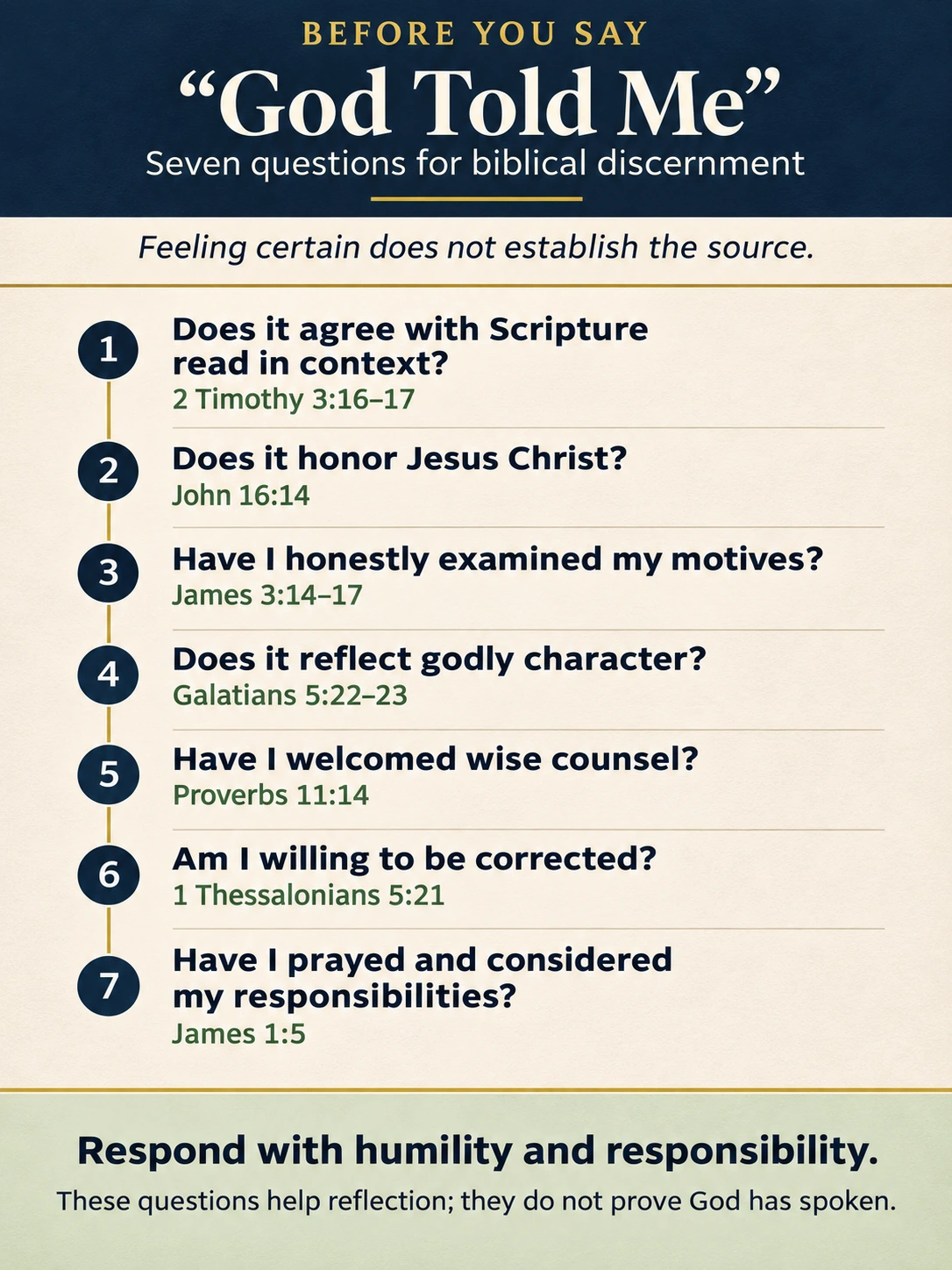
8 Seven questions for discernment
The New Testament calls believers to examine spiritual claims. First John 4:1–3 specifically addresses false prophets and their confession of Jesus Christ. Applying its principle to personal impressions is a pastoral extension of that concern; the passage is not a psychological checklist for identifying the source of a thought.
First Thessalonians 5:19–22 joins receptiveness to the Spirit and prophecy with examination of what is presented. First Corinthians 14:29 calls for the evaluation of prophetic speech. These passages challenge the idea that a claimed spiritual message must be accepted without question.
Christians disagree about the form and continuation of some spiritual gifts. Nevertheless, these texts clearly challenge the idea that every claimed spiritual message must be accepted without examination.
These seven questions gather biblical principles for reflection. They are not a scoring system, and answering yes to them does not prove that God has spoken. A clear conflict with biblical teaching requires rejecting the proposed action; uncertainty often calls for more prayer, learning, or counsel.
Does it agree with Scripture read in context
Second Timothy 3:16–17 teaches the value of Scripture for teaching, correction, and equipping believers. If an alleged spiritual direction requires dishonesty, cruelty, greed, or another action clearly contrary to biblical teaching, the Christian should reject that direction. Scripture must also be read in context. Selecting an isolated verse to defend a decision is not the same thing as faithfully interpreting God's Word.
For a practical approach to reading a passage in its setting, see How to Study the Bible.
Does it honor Jesus Christ
Jesus explains in John 16:14 that the Spirit will glorify Him. A claimed spiritual revelation that primarily elevates an individual's importance, grants immunity from correction, or demands unquestioning personal loyalty deserves careful scrutiny. Genuine Christian discernment should direct attention toward Christ and His teaching.
Have I honestly examined my motives
James 3:14–17 contrasts jealousy and selfish ambition with wisdom from above. We should ask whether fear, resentment, pride, personal advantage, or a desire for approval may be influencing our interpretation. The presence of emotion does not automatically make a judgment wrong. But unexamined motives can make us less reliable interpreters of our experiences.
Does it reflect godly character
Galatians 5:22–23 describes the character the Spirit produces, including love, patience, gentleness, and self-control. This gives us standards for examining patterns of conduct and maturity. Neither momentary confidence nor a desirable result can substitute for those standards.
But fruit should not be reduced to immediate results. An easy outcome is not automatically divine approval, and a difficult outcome is not automatically evidence of disobedience. Even faithful obedience can involve hardship.
Have I welcomed wise counsel
Proverbs 11:14 emphasizes the value of wise counsel, while 1 Corinthians 14:29 demonstrates that even claimed spiritual messages should be evaluated. A person who refuses every opportunity for accountability should not assume that refusal demonstrates stronger faith. At the same time, seeking counsel does not mean surrendering one's conscience to a leader or allowing someone else to control personal decisions through spiritual pressure. Healthy discernment values wisdom, accountability, and personal responsibility.
Am I willing to be corrected
There is a meaningful difference between saying, “I believe God may be directing me,” and claiming certainty about something Scripture has not clearly revealed. Humility allows us to consider other possibilities. It also allows us to change direction when we recognize that we were mistaken. The Holy Spirit does not require us to pretend that our own understanding is infallible.
Have I prayed and considered my responsibilities
James 1:5 encourages believers to seek wisdom from God. Prayer is not opposed to careful thinking. Nor does careful thinking demonstrate a lack of faith. Some decisions involve explicit biblical commands. Others involve prudence, available information, and legitimate choices among several acceptable options. Not every decision requires a supernatural sign. Christian maturity includes developing the wisdom to act faithfully without turning every personal preference into a divine instruction.
9 When spiritual language becomes pressure
This distinction has consequences beyond individual decision-making. A claim of divine guidance can carry extraordinary influence within a church. When someone says, “God told me you must do this,” the person receiving the instruction may feel that disagreement would mean disobeying God. That pressure can become spiritually harmful.
For example, a church leader might claim that the Holy Spirit requires someone to make a financial contribution. Yet 2 Corinthians 9:7 teaches that giving should not be motivated by compulsion. Another person might claim divine authority for a personal demand while refusing questions or accountability. But Scripture calls believers to examine spiritual claims rather than accept them automatically.
This does not mean every leader who speaks of God's guidance is manipulative. Many speak sincerely and responsibly. It means that claiming to speak under the Spirit's direction does not exempt a human being from biblical examination. Christians should be especially cautious when spiritual language is used to produce fear, silence reasonable questions, protect wrongdoing, or make another person dependent upon someone's supposed private access to God's will.
If a claim involves wrongdoing or coercion, independent counsel can help you evaluate it without treating the person making the claim as the final authority. The same principle of checking interpretations applies when spiritual claims come through digital tools; see AI Bible Study and the Holy Spirit.
The Holy Spirit cannot be manipulated into endorsing falsehood. But human beings can manipulate other people's understanding of the Holy Spirit.
10 Discernment without constant suspicion
This article is not an invitation to distrust every conviction or accuse other believers of false spirituality. The aim is mature faith that values conscience, welcomes the Spirit’s work, and remains honest about the limits of personal interpretation.
A Christian can recognize the limitations of conscience while still valuing it. A Christian can believe the Spirit guides believers while acknowledging that personal interpretations can be mistaken. And Christians can test spiritual claims without becoming cynical about the supernatural work of God.
If we acknowledge our limitations, we become more willing to study Scripture carefully, listen to correction, consider our motives, and recognize the difference between what God has clearly revealed and what we personally infer.
We can act on clear biblical responsibilities without first proving the supernatural origin of every thought. We can also admit uncertainty about a particular impression without abandoning trust in God. The danger comes when a conviction is given so much authority that it can no longer be examined.
Conclusion
Scripture presents a conscience that can accuse or defend, become weak or corrupted, and require correction. Christian faith identifies the Holy Spirit as truthful. Recognizing the difference protects both the seriousness of conscience and the authority of God.
Yet Christians remain capable of confusing their own thoughts and convictions with His guidance. This is why biblical discernment matters. We must not mistake emotional intensity for spiritual authority, personal certainty for divine confirmation, or the absence of guilt for proof of righteousness. Nor should we dismiss the conscience as worthless or assume the Spirit never works through our moral awareness. The Christian calling is to seek a conscience increasingly shaped by God's truth, to remain receptive to the Spirit's work, and to evaluate our interpretations with humility.
Before declaring that an impression came from the Holy Spirit, we should ask whether it agrees with Scripture, whether we have examined our motives, and whether we remain willing to be corrected. Those questions express dependence on God rather than doubt about His truthfulness.
The Holy Spirit cannot be wrong. But I can be wrong about whether I have heard Him.
Recognizing that truth is not a rejection of faith. It is an expression of the humility that faithful discernment requires.
Questions readers ask
Is my conscience the same as the Holy Spirit
No. Conscience is a human capacity for evaluating right and wrong. The Holy Spirit is divine in Trinitarian Christian belief. They can work together, as Romans 9:1 illustrates, but conscience remains capable of error. An inner conviction should not receive divine authority simply because it feels sincere or strong.
Can a Christian’s conscience be mistaken
Yes. First Corinthians 8:7–13 describes believers whose consciences are affected by an incomplete understanding of food associated with idols. Titus 1:15 and 1 Timothy 4:1–2 give broader warnings about corrupted conscience in the context of false teaching. These passages call for instruction and humility, not the rejection of conscience.
Does feeling peace mean God approves of my decision
Not necessarily. Philippians 4:6–7 describes God’s peace in the setting of prayer and anxious concerns. It does not say that feeling calm guarantees a decision is correct. Peace can be meaningful, but a decision also needs examination against Scripture, honest motives, wise counsel, and responsible consideration of the facts.
How can I tell whether God is directing me
Begin with what Scripture clearly teaches. Pray for wisdom, examine your motives, consider the character of the proposed action, and welcome counsel and correction (2 Timothy 3:16–17; James 1:5; 1 Thessalonians 5:19–22). No emotional sensation or seven-question checklist can guarantee the source of an impression. Where Scripture leaves several faithful options open, responsible judgment remains appropriate.
Should I ignore a conscience that may be mistaken
No. Romans 14:22–23 warns against acting while believing the action is wrong, in a discussion of food and disputed practices. Seek understanding rather than forcing yourself or someone else to suppress genuine moral concerns. Read Scripture in context, ask questions, and allow conscience to be corrected patiently without treating every existing conviction as permanent truth.
Scripture references in the NCV
Reference translation: The Holy Bible, New Century Version, Thomas Nelson, 2005. All passage links in this article open the NCV. The exposition consists of original summaries and interpretations rather than verbatim NCV verse quotations.
Conscience and moral responsibility: Romans 2:14–15; Romans 9:1; Romans 14:22–23; 1 Timothy 1:5, 19.
Limits of conscience and the context of idol food: 1 Corinthians 4:1–5; 1 Corinthians 8:7–13; 1 Corinthians 10:14–22; Titus 1:15–16; 1 Timothy 4:1–2.
The Spirit’s character and work: John 14:16–17; John 16:13–14; 1 Corinthians 2:10–11; Acts 5:3–4; Ephesians 4:30; Acts 7:51; 1 Thessalonians 5:19–22.
Religious certainty and human error: Acts 9:1–6; Acts 23:1; Acts 26:9–11; Galatians 2:11–14.
Testing claims and forming character: 1 John 4:1–3; 1 Corinthians 14:29; 2 Timothy 3:16–17; Galatians 5:22–23; James 1:5; James 3:13–17; Proverbs 11:14; Philippians 4:6–7; 2 Corinthians 9:7.
Read each passage in its literary and historical context. The article distinguishes what a passage directly describes from the theological conclusions and pastoral applications drawn from it.
Scientific references
These peer-reviewed publications address human judgment, not experimental verification of the Holy Spirit. They include theoretical models, research syntheses, and empirical studies; they should not be treated as six equivalent experiments. DOI links lead to the scholarly records, where full-text access may depend on the publisher.
1. Haidt, J. (2001). The emotional dog and its rational tail: A social intuitionist approach to moral judgment. Psychological Review, 108(4), 814–834. https://doi.org/10.1037/0033-295X.108.4.814
2. Kunda, Z. (1990). The case for motivated reasoning. Psychological Bulletin, 108(3), 480–498. https://doi.org/10.1037/0033-2909.108.3.480
3. Bandura, A. (1999). Moral disengagement in the perpetration of inhumanities. Personality and Social Psychology Review, 3(3), 193–209. https://doi.org/10.1207/s15327957pspr0303_3
4. Pronin, E., Lin, D. Y., & Ross, L. (2002). The bias blind spot: Perceptions of bias in self versus others. Personality and Social Psychology Bulletin, 28(3), 369–381. https://doi.org/10.1177/0146167202286008
5. Greene, J. D., Sommerville, R. B., Nystrom, L. E., Darley, J. M., & Cohen, J. D. (2001). An fMRI investigation of emotional engagement in moral judgment. Science, 293(5537), 2105–2108. https://doi.org/10.1126/science.1062872
6. Julmi, C. (2024). Analysis and intuition effectiveness in moral problems. Journal of Business Ethics, 191(1), 179–193. First published online April 4, 2023. https://doi.org/10.1007/s10551-023-05407-y
Related reading
How to Study the Bible: Read passages in context and develop a consistent approach to study.
AI Bible Study and the Holy Spirit: Evaluate research tools and interpretations without surrendering discernment.
About this resource: El Roi Digital Ministries is responsible for this resource, with research and editorial direction by Michael Gatica. See our editorial standards for our approach to sources, human review, and corrections.