
The short answer
The Ethiopian Orthodox Tewahedo biblical tradition and the King James Bible come from different Christian histories. The Ethiopian tradition is commonly described as having an 81-book canon, although scholarly studies show that the total is reached through more than one list and that the relationship between a church canon, a manuscript, and a printed edition is complex. The KJV is an English translation produced for the Church of England and first published in 1611; the standard Protestant arrangement used in most modern KJV printings contains 66 books. A book-count comparison is therefore useful only when canon, translation, and edition are kept separate.
Why the comparison needs care
Online discussions often ask, “Which Bible has more books?” That is a reasonable starting question, but it can become misleading when three different subjects are treated as one.
Canon
A canon is a community’s recognized body of authoritative Christian writings. The word is often used as if every church has one universally fixed list that can be counted in exactly the same way. Historical evidence is more complicated. Churches have used different collections, different groupings, and different levels of authority for books used in worship, teaching, church order, and devotion.
Translation
A translation is a rendering of a text from one language into another. The King James Bible is an English translation made from the Hebrew, Aramaic, and Greek textual resources available to its translators, while also drawing heavily on earlier English translations. The Ethiopian biblical tradition is associated with Ge’ez, or Classical Ethiopic, and with a long history of translation, revision, reception, and use in the Ethiopian church. It is not accurate to call every English book marketed as “the Ethiopian Bible” a translation of the entire Ethiopian biblical corpus.
Edition
An edition is a particular published form of a text. Two books may both be called “KJV” and differ in spelling, punctuation, paragraphing, notes, Apocrypha, and textual presentation. The 1611 King James Bible included the Apocrypha between the Testaments, while many modern Protestant KJV printings contain only the 66 books of the standard Protestant arrangement. Likewise, an English volume advertised as an “81-book Ethiopian Bible” may be a selection, a composite, a partial translation, or a reprint whose contents need to be checked book by book.
Keeping these distinctions visible is the best protection against sensational claims.
What the Ethiopian Orthodox Tewahedo tradition represents
The Ethiopian Orthodox Tewahedo Church has preserved a distinctive Christian literary and liturgical heritage in Ge’ez, Amharic, and other Ethiopian languages. The Ethiopic biblical corpus is important not only for Ethiopian Christianity but also for the study of how Jewish and Christian writings were translated, transmitted, interpreted, and received in Africa and the wider eastern Mediterranean world. The Cambridge history of the Bible describes the Ethiopic canon as including the Hebrew Bible, later Jewish literature, and the Christian New Testament, while also emphasizing the value of Ethiopic literature for the history of biblical transmission.[1]
The number 81 is widely associated with the Ethiopian Orthodox biblical canon. Yet scholars have repeatedly warned that the count is not produced by one universally identical table of contents. R. W. Cowley’s study of the Ethiopian Orthodox canon showed that lists vary, that book names may not identify exactly the same work in every source, and that the church’s authorities have not declared one Ge’ez or Amharic printing to be the complete Bible.[2] G. A. Mikre-Sellassie likewise described narrower and broader forms of the canon and noted that traditional lists can reach the number 81 in different ways.[3]
This does not mean the Ethiopian tradition is confused or illegitimate. It means that its history should not be forced into a modern Western publishing model in which one printed table of contents is assumed to settle every question. Canonical recognition, liturgical use, manuscript availability, and the contents of a modern edition are related but not identical questions.
The tradition is also especially important for the study of books such as 1 Enoch and Jubilees, which survive in complete Ethiopic form even though they are not part of the standard Protestant Bible. Their preservation does not automatically answer every theological question about authority for every Christian tradition. It does show that the history of Christian Scripture is broader than the contents of any single modern English Bible.
What the King James Bible represents
The King James Bible was commissioned during the reign of James VI and I and published in 1611. The translation was a collective project involving companies of scholars working in Westminster, Oxford, and Cambridge. Cambridge’s historical account notes that the project was intended to produce a uniform English translation for use in the Church of England and that the translation companies worked with earlier English versions rather than starting from nothing.[4]
The KJV therefore should not be described as a translation created in isolation from the Reformation-era English Bible. It stands in a line that includes William Tyndale, the Great Bible, the Geneva Bible, and the Bishops’ Bible. Its literary influence is immense, but its historical identity is still that of a translation produced in a particular ecclesial and political setting.
The first edition also included the Apocrypha. This matters when comparing the “1611 KJV” with the standard 66-book Protestant arrangement used by many KJV readers today. David Norton’s textual history documents how the KJV was edited, corrected, and standardized after 1611, while Gordon Campbell’s history explains how the translation’s text and reception developed across four centuries.[5][6] A modern reader should therefore ask whether “KJV” means the original 1611 presentation, a later standardized KJV text, or a particular publisher’s edition.
Comparison chart
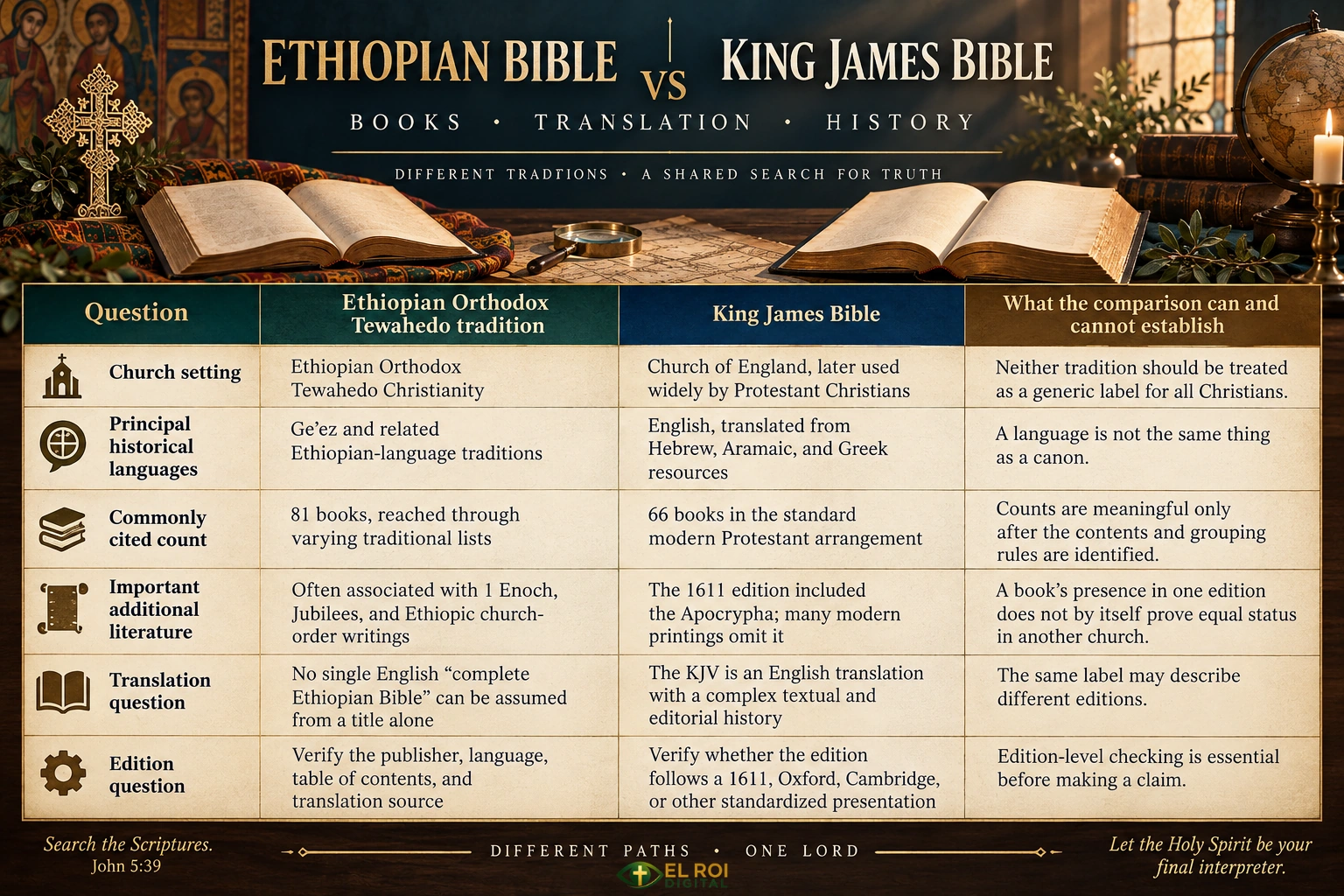
| Question | Ethiopian Orthodox Tewahedo tradition | King James Bible | What the comparison can and cannot establish |
|---|---|---|---|
| Church setting | Ethiopian Orthodox Tewahedo Christianity | Church of England, later used widely by Protestant Christians | Neither tradition should be treated as a generic label for all Christians. |
| Principal historical languages | Ge’ez and related Ethiopian-language traditions | English, translated from Hebrew, Aramaic, and Greek resources | A language is not the same thing as a canon. |
| Commonly cited count | 81 books, reached through varying traditional lists | 66 books in the standard modern Protestant arrangement | Counts are meaningful only after the contents and grouping rules are identified. |
| Important additional literature | Often associated with 1 Enoch, Jubilees, and Ethiopic church-order writings | The 1611 edition included the Apocrypha; many modern printings omit it | A book’s presence in one edition does not by itself prove equal status in another church. |
| Translation question | No single English “complete Ethiopian Bible” can be assumed from a title alone | The KJV is an English translation with a complex textual and editorial history | The same label may describe different editions. |
| Edition question | Verify the publisher, language, table of contents, and translation source | Verify whether the edition follows a 1611, Oxford, Cambridge, or other standardized presentation | Edition-level checking is essential before making a claim. |
How to evaluate an English edition
Before buying, citing, or recommending an English volume marketed as an Ethiopian Bible, check the following:
- Does the publisher identify the translator or translation team?
- Does the book provide a complete table of contents?
- Does it distinguish Ge’ez, Amharic, and English texts?
- Does it explain whether the volume follows a broader or narrower canon?
- Are 1 Enoch, Jubilees, the Meqabyan books, Sinodos, the Books of the Covenant, Ethiopic Clement, and Ethiopic Didascalia actually present, or merely mentioned?
- Are the books translated from a known Ethiopic text, adapted from another English translation, or reproduced without source information?
- Does the publisher identify the manuscript or critical edition used?
- Are book titles being confused with similarly named works from another Christian tradition?
- Does the physical book contain the text, or only a list of books and summaries?
- Can the claims be checked against a scholarly catalogue, university project, church publication, or academic reference work?
This checklist does not imply that a single English book must satisfy every reader. It simply helps readers describe the edition honestly.
What can responsibly be said about book counts
It is responsible to say that the Ethiopian Orthodox Tewahedo tradition is commonly associated with an 81-book canon and that the standard Protestant KJV arrangement contains 66 books. It is not responsible to imply that every source uses the same 81-item list, that every English edition contains every text, or that the difference proves a simple story in which one side “removed” books from the other.
The history of Christian canons developed across communities, languages, liturgical practices, and periods. Even within Western Christianity, Catholic, Orthodox, Anglican, and Protestant traditions do not organize biblical books identically. The KJV’s 1611 inclusion of the Apocrypha is a reminder that “the KJV” is not always identical to the contents of a modern 66-book Protestant printing.
The better question is not merely, “Which Bible has more books?” A better set of questions is:
- Which church or tradition is being described?
- Which list of books is being used?
- How are the books grouped and counted?
- What language and textual witnesses stand behind the translation?
- What exactly is in the edition being sold or cited?
Historical description and spiritual interpretation
Historical research can identify manuscripts, translation histories, book lists, publication dates, and patterns of reception. It can help readers understand why traditions differ and can correct careless internet claims. It cannot replace prayer, the life of the church, or the Holy Spirit’s work in helping believers receive and apply Scripture.
Reader questions
Does the Ethiopian Bible really have 81 books?
The number 81 is the standard figure associated with the Ethiopian Orthodox Tewahedo canon. Scholarly studies show that different lists and grouping practices can reach that total, so readers should not assume every English edition has identical contents.
Is the Ethiopian Bible a translation or a canon?
It is best discussed first as a church tradition with a distinctive biblical corpus and history. An English book sold under that name is an edition or translation project and must be evaluated separately.
Is the King James Bible only 66 books?
Most modern Protestant KJV printings contain the 66 books of the standard Protestant arrangement. The 1611 edition also printed the Apocrypha, so the exact edition matters.
Was the Book of Enoch removed from the King James Bible?
That wording oversimplifies the history. 1 Enoch was not part of the standard Protestant Old Testament arrangement used by the KJV translators, while it has a distinctive place in Ethiopian Christian tradition. The traditions did not begin with one identical canon that was later edited by a single event.
Does a larger canon automatically make one Bible more accurate?
No. Book count alone does not settle questions of authority, interpretation, textual history, or the relationship between a church’s liturgy and its printed editions.
What should I check before buying an “81-book Ethiopian Bible” in English?
Check the translator, publisher, table of contents, source language, edition notes, and whether the advertised books are actually printed in full.
Sources and further reading
The numbered notes correspond to citations in the article. Additional works from the reviewed bibliography follow.
- Ephraim Isaac. "The Bible in Ethiopic." In The New Cambridge History of the Bible, volume 2, edited by Richard Marsden and E. Ann Matter, 110–122. Cambridge University Press, 2012. https://doi.org/10.1017/CHOL9780521860062.008 ↩
- Cowley, R. W. "The Biblical Canon of the Ethiopian Orthodox Church Today." Ostkirchliche Studien 23 (1974): 318-323. ↩
- Mikre-Sellassie, G. A. "The Bible and Its Canon in the Ethiopian Orthodox Church." The Bible Translator 44, no. 1 (1993): 111-123. https://doi.org/10.1177/026009359304400102 ↩
- Hamlin, Hannibal, and Norman W. Jones. "Introduction." In The King James Bible after Four Hundred Years: Literary, Linguistic, and Cultural Influences, 1–24. Cambridge University Press, 2010. https://doi.org/10.1017/CBO9780511779800.001 ↩
- Norton, David. A Textual History of the King James Bible. Cambridge University Press, 2005. https://www.cambridge.org/core/books/textual-history-of-the-king-james-bible/56CC9D62A1BA8D18B98C8BF8BB638166 ↩
- Campbell, Gordon. Bible: The Story of the King James Version, 1611-2011. Oxford University Press, 2010. https://academic.oup.com/book/5443 ↩
- Asale, Bruk A. "The Ethiopian Orthodox Tewahedo Church Canon of the Scriptures: Neither Open nor Closed." The Bible Translator 67, no. 2 (2016): 202-222. https://doi.org/10.1177/2051677016651486
- Barton, John. A History of the Bible: The Book and Its Faiths. Allen Lane, 2019.
- Barton, John. Oracles of God: Perceptions of Ancient Prophecy in Israel after the Exile. Oxford University Press, 1986.
- Charles, R. H., ed. The Apocrypha and Pseudepigrapha of the Old Testament in English: With Introductions and Critical and Explanatory Notes to the Several Books. 2 vols. Clarendon Press, 1913.
- Cross, Frank Moore, and Shemaryahu Talmon, eds. Qumran and the History of the Biblical Text. Harvard University Press, 1975.
- Knibb, Michael A. Translating the Bible: The Ethiopic Version of the Old Testament. Oxford University Press, 1999.
- McDonald, Lee Martin. The Biblical Canon: Its Origin, Transmission, and Authority. 3rd ed. Hendrickson Publishers, 2007.
- Metzger, Bruce M. An Introduction to the Apocrypha. Oxford University Press, 1957.
- Ulrich, Eugene. The Dead Sea Scrolls and the Origins of the Bible. Eerdmans, 1999.
- Ullendorff, Edward. Ethiopia and the Bible. Oxford University Press, 1968.
- Assefa, Daniel. "The Biblical Canon of the Ethiopian Orthodox Tawāhǝdo Church." In The Oxford Handbook of the Bible in Orthodox Christianity, edited by Eugen J. Pentiuc. Oxford University Press, 2022. https://academic.oup.com/edited-volume/41986/chapter-abstract/355425440.