
The short answer
Direct answer
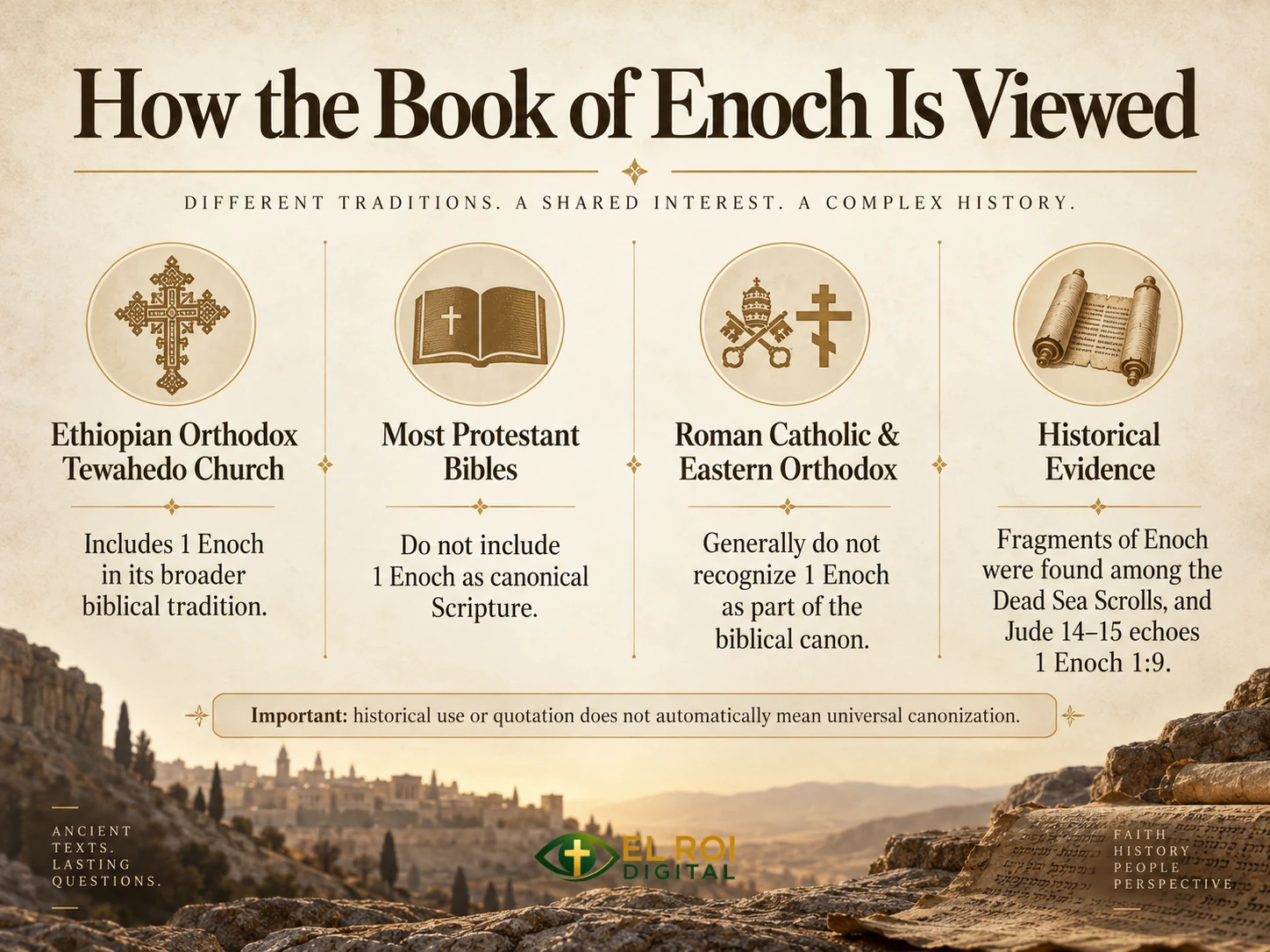
1 Enoch is an ancient Jewish collection preserved complete in Ge'ez and received as Scripture in the Ethiopian Orthodox Tewahedo Church. It is not included in the Jewish Tanakh, the standard Protestant or Roman Catholic canons, or most Eastern Orthodox Old Testament canons. Jude 14-15 quotes a prophecy corresponding to 1 Enoch 1:9, but that quotation alone does not make the whole collection canonical for every Christian tradition.
The real issue is not whether Enoch was secretly removed from one universal Bible. Christian communities inherited and organized different collections. A responsible answer must distinguish four subjects that are often blended together online: the history of the text, the manuscripts that preserve it, the canon of a particular worshiping community, and the contents of a particular printed edition.
That distinction allows Christians to take 1 Enoch seriously without sensationalism. The work is ancient, influential, and important for understanding parts of Second Temple Judaism and the New Testament world. Its canonical status, however, is tradition-specific rather than universal.
What the title "Book of Enoch" usually means
In most modern discussions, "the Book of Enoch" means 1 Enoch. Other works called 2 Enoch and 3 Enoch belong to different languages, periods, and literary settings. They should not be combined as though they were one continuous book.
First Enoch speaks through Enoch, the figure in Genesis 5 who walked with God and was taken. Modern critical scholarship treats the surviving work as a pseudonymous and composite collection: several Jewish writings were attributed to Enoch and edited together over time. This judgment concerns literary composition; it does not make the text insignificant. Pseudonymous writing was an ancient way of placing instruction within the voice and authority of a revered figure.
Research basis: Nickelsburg 2001; Nickelsburg and VanderKam 2012; Collins 2016; VanderKam 1984. [15, 16, 8, 21]
How 1 Enoch was composed
The collection did not appear all at once. Its major sections address related themes but come from different stages of composition and editing. The following dates are responsible scholarly ranges, not exact publication dates.
| Section | Chapters | Primary emphasis | Approximate scholarly dating |
|---|---|---|---|
| Book of the Watchers | 1-36 | Rebellious angels, giants, forbidden knowledge, heavenly journeys, and judgment. | Core commonly dated to the 3rd century BCE; layered. |
| Parables / Similitudes | 37-71 | The Elect One or Son of Man, final judgment, and vindication of the righteous. | Most disputed; often placed in the late 1st century BCE or 1st century CE. |
| Astronomical Book | 72-82 | Calendars, heavenly order, the sun, moon, stars, and seasons. | Early Enochic material, generally 3rd century BCE; layered. |
| Dream Visions | 83-90 | Flood visions and the Animal Apocalypse, a symbolic retelling of history. | Generally 2nd century BCE. |
| Epistle of Enoch | 91-108 | Wisdom, woes, judgment, resurrection hope, and exhortation. | Layered material commonly assigned to the 2nd-1st centuries BCE. |
Dating note: individual units may be older than the form in which they now appear, and the date of the Parables remains especially debated. See Nickelsburg 2001; Collins 2016; VanderKam 1984; Stuckenbruck 2014. [15, 8, 21, 19]
What the manuscript evidence establishes
The complete text of 1 Enoch survives in the Ge'ez textual tradition preserved by Ethiopian Christianity. The Ge'ez text is indispensable, but it is a translation rather than the original-language autograph. Earlier partial witnesses survive in other languages.
Aramaic fragments discovered among the Dead Sea Scrolls show that substantial portions of Enochic literature circulated in Jewish communities before Christianity. The Israel Antiquities Authority identifies 4Q204 as a manuscript of 4Q Enoch. Greek portions and ancient quotations also preserve stages of the work's transmission. These witnesses allow scholars to compare the later complete Ge'ez tradition with much earlier fragmentary evidence.
The limits of the evidence matter. No fragments of the Parables or Similitudes have been identified among the Qumran Enoch manuscripts. The Dead Sea Scrolls therefore attest important parts of 1 Enoch, but they do not provide a complete copy of all five sections.
Manuscript conclusion
Say that the complete work survives in Ge'ez, while earlier partial evidence survives in Aramaic and Greek. Do not call Ge'ez the original language, do not call a later complete manuscript an autograph, and do not claim that Qumran preserves every section.
Research basis: Knibb 1978; Black 1985; Israel Antiquities Authority, 4Q204; Nickelsburg and VanderKam 2012. [13, 4, 12, 16]
Is 1 Enoch part of the Bible?
The answer depends on which community's canon is being described. Canon is not merely a modern publisher's table of contents; it is a community's received collection of sacred writings, expressed through worship, teaching, manuscripts, lists, and editions.
| Community or tradition | Status of 1 Enoch |
|---|---|
| Ethiopian Orthodox Tewahedo Church | Canonical. The church's published English list includes Enoch and counts 46 Old Testament and 35 New Testament books. |
| Jewish Tanakh | Not included. |
| Standard Protestant canon | Not included in the usual 66-book arrangement. |
| Roman Catholic canon | Not included. |
| Most Eastern Orthodox Old Testament canons | Not included; local canonical and liturgical traditions should still be identified rather than assumed. |
The Ethiopian Orthodox Tewahedo Church's published English canon page counts 46 Old Testament books and 35 New Testament books, totaling 81, and explicitly lists Enoch. That official statement should be reported plainly and respectfully.
The number 81 still requires explanation. Scholarly studies by R. W. Cowley, G. A. Mikre-Sellassie, and Bruk A. Asale show that lists, groupings, manuscript practice, and the concept of canon in Ethiopian tradition are more complex than a single commercial label suggests. An English book marketed as an "81-book Ethiopian Bible" should therefore be checked by its actual contents, translation base, and editorial claims. Canon, manuscript collection, translation, and printed edition are related but not identical.
This history does not support the claim that one universally accepted Bible was secretly edited to remove Enoch from every church. It supports a more careful conclusion: Christian communities received different collections, and the Ethiopian church preserved 1 Enoch both textually and canonically.
Research basis: Ethiopian Orthodox Tewahedo Church; Asale 2016; Cowley 1974; Mikre-Sellassie 1993; Gallagher and Meade 2017. [10, 1, 9, 14, 11]
Why Jude 14-15 matters
Jude 14-15 is the clearest New Testament relationship to 1 Enoch. Jude names Enoch, "the seventh from Adam," and presents a judgment prophecy whose wording corresponds closely to 1 Enoch 1:9. Scholars widely recognize this as a quotation or very close reproduction of the Enochic passage.
Two truths should be held together. First, Jude does not use the prophecy casually; it functions authoritatively within Jude's inspired argument. Dismissing the relationship as meaningless understates the evidence. Second, Jude's use of one Enochic prophecy does not automatically answer how every later Jewish or Christian community should classify the entire composite collection. A source can be quoted, used, or received with authority in one context without every part of that source becoming canonical in every tradition.
The sound question is therefore not only, "Does Jude quote Enoch?" He does. The fuller questions are: What role does the quotation play in Jude, what is the textual history of 1 Enoch 1:9, and how did particular worshiping communities recognize their canon?
Research basis: Bauckham 1983; Osburn 1977; Charles 1991; Nickelsburg and VanderKam 2012. [3, 17, 5, 16]
Early Christian reception was not uniform
Early Christian writers did not speak with one voice about writings associated with Enoch. Tertullian defended "the Scripture of Enoch," acknowledged that some did not receive it, and appealed to Jude in its support. Centuries later, Augustine accepted Jude's testimony that Enoch left divine writings but argued that the writings circulating under Enoch's name lacked canonical authority because their transmission and genuineness were uncertain.
Neither writer represents every early Christian community. Together, however, they demonstrate that reception varied. The historical record is more complex than either "the whole church accepted Enoch" or "the church secretly banned it." Ethiopian Christianity preserved a living canonical reception; many other traditions did not.
Primary evidence: Tertullian, On the Apparel of Women 1.3; Augustine, City of God 15.23. Historical analysis: Reed 2005; Stuckenbruck 2014. [20, 2, 18, 19]
How Christians can read 1 Enoch responsibly
First Enoch can illuminate the imaginative and theological world of ancient Judaism. It can help readers understand the development of Watchers traditions, angelic rebellion, heavenly judgment, apocalyptic symbolism, resurrection hope, and the vindication of the righteous. It can also clarify why themes in Jude and 2 Peter sounded familiar to ancient audiences.
Use the following reading practice:
- Read the biblical passage in its own literary and historical context before using Enoch as background.
- Identify the specific Enochic section under discussion; do not treat the five-part collection as one undifferentiated voice.
- Use a reliable modern translation and note where the Aramaic, Greek, and Ge'ez evidence differs or is incomplete.
- Distinguish historical influence from canonical authority and canonical authority from modern application.
- Name the church tradition whose canon is being described instead of presenting one tradition as universal.
- Mark disputed dates, readings, and interpretations as uncertain rather than turning them into spiritual certainty.
The work should not become a proof-text machine, a replacement for Scripture, or a source of hidden dates and end-times certainty. It is most useful when it leads readers back to careful study of Genesis, Daniel, Jude, Peter, the Gospels, and Revelation rather than becoming a master key forced into every difficult passage.

El Roi ministry principle
Historical research is a servant, not the final authority. For El Roi Digital Ministries, the Holy Spirit remains the final determiner in faithful Christian interpretation, working through Scripture, prayer, and accountable Christian community. Scholarship can clarify what the evidence supports; it cannot replace spiritual discernment or pastoral responsibility.
Which English edition should I use?
No single English edition should be advertised as though it were the official voice of every Ethiopian manuscript or the entire Ethiopian biblical tradition. For study, choose an edition according to purpose.
| Edition | Editorial assessment | Best use |
|---|---|---|
| Nickelsburg and VanderKam, 2012 | Best starting point for a current, readable scholarly translation. | Accessible scholarly reading |
| E. Isaac in Charlesworth, 1983 | A widely cited English translation in a major reference collection. | General research and comparison |
| Knibb, 1978 | A technical two-volume edition developed in light of the Aramaic Dead Sea Scroll fragments. | Textual and advanced study |
| R. H. Charles, 1912 | Historically important and public domain, but its translation and notes are dated. | Historical comparison, not the sole critical edition |
Editorial recommendation: use Nickelsburg and VanderKam 2012 for most readers; consult Knibb 1978 or specialized commentaries for advanced textual questions.
Common claims checked
| Popular claim | Better assessment |
|---|---|
| "Enoch was removed from every Bible." | Historically inaccurate. Canon lists differ, and 1 Enoch remains canonical in the Ethiopian Orthodox Tewahedo Church. |
| "Jude quotes Enoch, so the whole collection is Scripture for every church." | Too strong. Jude uses the prophecy authoritatively in his argument, but one quotation does not by itself define every community's complete canon. |
| "Ge'ez is the original language of 1 Enoch." | Unsupported. The complete work survives in Ge'ez, but the Ge'ez text is a translation. Earlier partial witnesses survive in Aramaic and Greek. |
| "The Dead Sea Scrolls prove that Enoch is Christian Scripture." | Misleading. The Qumran manuscripts demonstrate Jewish circulation and importance before Christianity; they do not establish a later Christian canon. |
| "All five sections of 1 Enoch were found at Qumran." | Incorrect. No fragments of the Parables or Similitudes have been identified among the Qumran Enoch manuscripts. |
| "Any English book advertised as an 81-book Ethiopian Bible contains the entire Ethiopian canon." | Do not assume this. Verify the actual table of contents, translation base, grouping, and edition claims. |
| "The early church unanimously accepted or unanimously rejected Enoch." | Incorrect. Reception varied. Tertullian defended it, while Augustine denied canonical authority to writings circulating under Enoch's name. |
Frequently asked questions
Is the Book of Enoch part of the Bible?
It is part of the Ethiopian Orthodox Tewahedo biblical canon. It is not included in the Jewish Tanakh or the standard Protestant, Roman Catholic, and most Eastern Orthodox Old Testament canons.
Did the Enoch in Genesis personally write 1 Enoch?
Modern critical scholarship treats 1 Enoch as a pseudonymous collection produced and edited by multiple ancient Jewish writers, not as a surviving manuscript personally written before the flood.
Which New Testament passage quotes Enoch?
Jude 14-15 names Enoch, the seventh from Adam, and uses a prophecy corresponding closely to 1 Enoch 1:9.
What is the oldest complete version of 1 Enoch?
The complete work survives in the Ge'ez textual tradition. Much earlier partial evidence survives in Aramaic fragments from Qumran and in Greek witnesses, so the complete Ge'ez text should be studied alongside those earlier materials.
Should Christians read the Book of Enoch?
Christians may read it for historical, literary, and theological context while respecting their church's canonical teaching. It should not replace Scripture, control doctrine by itself, or become a source of hidden dates and end-times certainty.
Which English edition should a new reader use?
Nickelsburg and VanderKam's 1 Enoch: The Hermeneia Translation is a strong accessible starting point. E. Isaac's translation in The Old Testament Pseudepigrapha is also widely used.
Related El Roi Digital Ministries resources
Sources and further reading
The following primary, institutional, and scholarly sources support the article. Bibliographic details and stable links were checked during the final editorial review completed October 11, 2026.
- Asale, Bruk A. "The Ethiopian Orthodox Tewahedo Church Canon of the Scriptures: Neither Open nor Closed." The Bible Translator 67, no. 2 (2016): 202-222. Source link ↩
- Augustine. The City of God, book 15, chapter 23. Source link ↩
- Bauckham, Richard J. Jude, 2 Peter. Word Biblical Commentary 50. Waco, TX: Word Books, 1983. ↩
- Black, Matthew. The Book of Enoch or I Enoch: A New English Edition with Commentary and Textual Notes. With an Appendix on the "Astronomical" Chapters (72-82) by O. Neugebauer. Studies on the Texts of the Desert of Judah 7. Leiden: Brill, 1985. ↩
- Charles, J. Daryl. "Jude's Use of Pseudepigraphical Source-Material as Part of a Literary Strategy." New Testament Studies 37, no. 1 (1991): 130-145. Source link ↩
- Charles, R. H. The Book of Enoch or 1 Enoch: Translated from the Editor's Ethiopic Text. Oxford: Clarendon Press, 1912.
- Charlesworth, James H., ed. The Old Testament Pseudepigrapha. Vol. 1, Apocalyptic Literature and Testaments. Garden City, NY: Doubleday, 1983.
- Collins, John J. The Apocalyptic Imagination: An Introduction to Jewish Apocalyptic Literature. 3rd ed. Grand Rapids, MI: Eerdmans, 2016. ↩
- Cowley, R. W. "The Biblical Canon of the Ethiopian Orthodox Church Today." Ostkirchliche Studien 23 (1974): 318-323. ↩
- Ethiopian Orthodox Tewahedo Church. "The Holy Scriptures: The Books of the Bible." Source link ↩
- Gallagher, Edmon L., and John D. Meade. The Biblical Canon Lists from Early Christianity: Texts and Analysis. Oxford: Oxford University Press, 2017. ↩
- Israel Antiquities Authority, Leon Levy Dead Sea Scrolls Digital Library. "4Q Enoch" (4Q204). Source link ↩
- Knibb, Michael A., in consultation with Edward Ullendorff. The Ethiopic Book of Enoch: A New Edition in the Light of the Aramaic Dead Sea Fragments. 2 vols. Oxford: Clarendon Press, 1978. ↩
- Mikre-Sellassie, G. A. "The Bible and Its Canon in the Ethiopian Orthodox Church." The Bible Translator 44, no. 1 (1993): 111-123. Source link ↩
- Nickelsburg, George W. E. 1 Enoch 1: A Commentary on the Book of 1 Enoch, Chapters 1-36; 81-108. Hermeneia. Minneapolis: Fortress Press, 2001. ↩
- Nickelsburg, George W. E., and James C. VanderKam. 1 Enoch: The Hermeneia Translation. Minneapolis: Fortress Press, 2012. ↩
- Osburn, Carroll D. "The Christological Use of I Enoch 1.9 in Jude 14, 15." New Testament Studies 23, no. 3 (1977): 334-341. ↩
- Reed, Annette Yoshiko. Fallen Angels and the History of Judaism and Christianity: The Reception of Enochic Literature. Cambridge: Cambridge University Press, 2005. ↩
- Stuckenbruck, Loren T. The Myth of Rebellious Angels: Studies in Second Temple Judaism and New Testament Texts. Tübingen: Mohr Siebeck, 2014. Source link ↩
- Tertullian. On the Apparel of Women, book 1, chapter 3. Source link ↩
- VanderKam, James C. Enoch and the Growth of an Apocalyptic Tradition. Washington, DC: Catholic Biblical Association of America, 1984. ↩
About this study
This article describes evidence and denominational reception; it does not claim to speak officially for the Ethiopian Orthodox Tewahedo Church. The research was last verified October 11, 2026.