
The short answer
Start Christmas service planning with a one-sentence pastoral purpose, then build theology, hospitality, program order, production, safety, and follow-up around that purpose.
The guiding idea
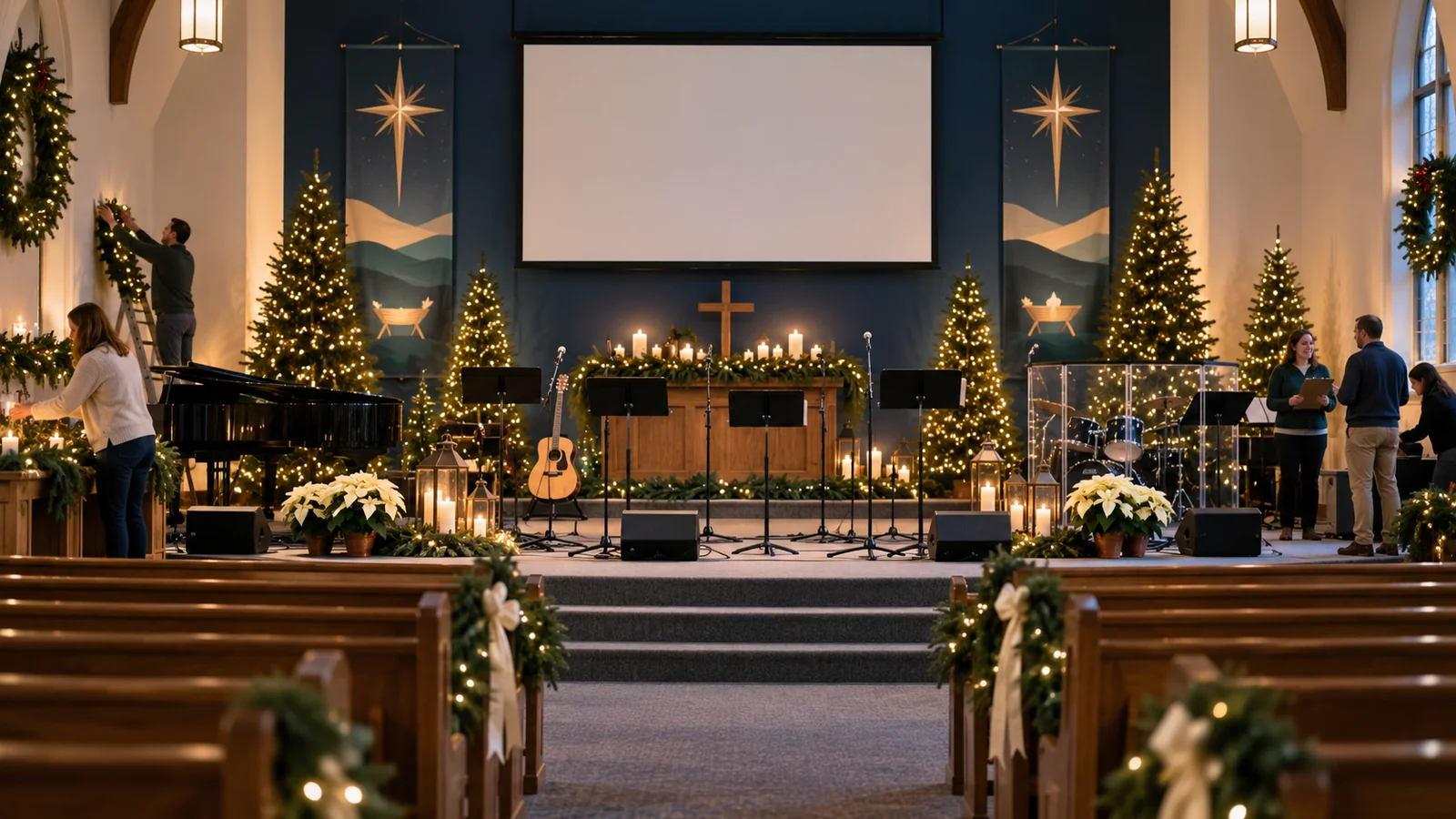
A Christmas service is not a show that happens to mention Jesus. It is a gathered act of worship in which theology, hospitality, music, Scripture, testimony, technology, and safety should serve one clear invitation: to hear and respond to the good news of the incarnation. Planning helps the church protect that invitation. It does not guarantee a spiritual outcome, and it should never be used to manipulate a response.
Begin with a one-sentence pastoral purpose. For example: “Our Christmas service will help neighbors encounter the hope of Christ through Scripture, congregational song, beauty, and a clear invitation to follow Jesus.” Every service element should support that purpose; revise or remove elements that do not.
Plan in layers
1. Theology and Scripture
Choose the primary texts before choosing the visual theme. Decide what the congregation should understand about God, humanity, the incarnation, hope, and response. Read the passages in context, consult trusted commentaries, and allow the Holy Spirit to govern the interpretation. A production team can clarify, but it must not flatten a rich text into a marketing slogan.
2. Congregational experience
Mark the moments where a first-time guest may be unsure: parking, childcare, seating, printed or digital directions, participation in communion, prayer, and the closing invitation. Explain unfamiliar practices briefly. Give people permission to observe without pressure. Accessibility is part of welcome: provide readable slides, captions when possible, good lighting for lip reading, wheelchair routes, quiet options, and a clear plan for sensory needs.
3. Program architecture
Build a run-of-show with purpose, owner, duration, transition, and backup. Include Scripture, prayer, music, testimony, teaching, giving instructions, and dismissal. Protect the sermon and the gospel invitation from last-minute additions. A transition that is planned can feel warm; a transition that is improvised can feel like dead air.
4. Production and safety
Schedule separate rehearsals for music, readers, children, lighting, slides, livestream, and emergency procedures. Test every cable and media file. Confirm licenses for music and video. Assign a service producer who can make real-time decisions without asking six people for permission. Establish a stop plan for a medical event, weather issue, child-safety concern, or technology failure.
A useful timeline
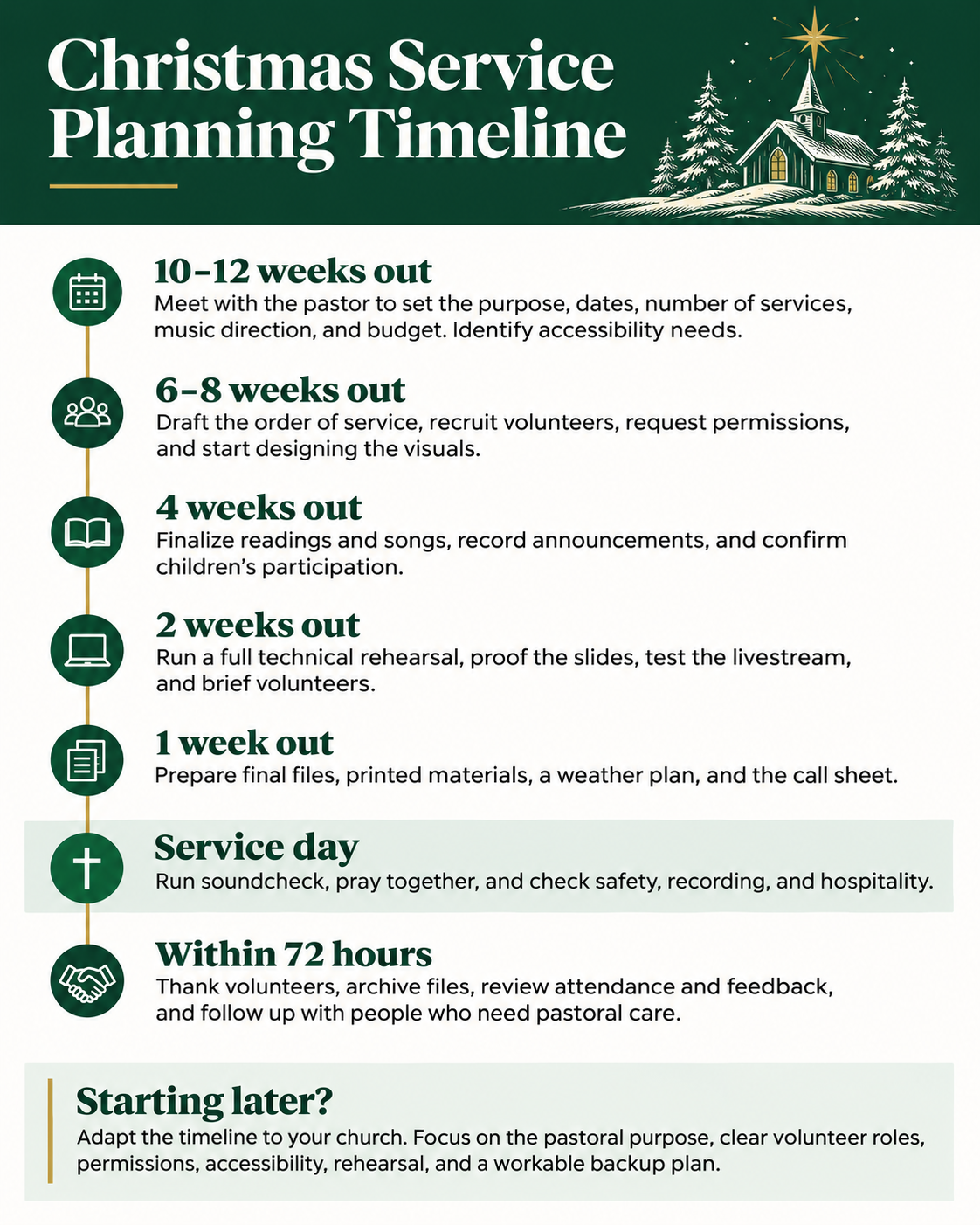
Read the timeline as text
| Time | Decision |
|---|---|
| 10–12 weeks out | Purpose, dates, service count, pastor, music direction, budget, accessibility needs |
| 6–8 weeks out | Draft order, recruit volunteers, request permissions, begin visual package |
| 4 weeks out | Lock readings and songs, record announcements, confirm children’s participation |
| 2 weeks out | Full technical test, slide proof, livestream test, volunteer briefing |
| 1 week out | Final files, printed materials, weather plan, call sheet |
| Service day | Soundcheck, prayer, safety check, recording check, hospitality check |
| Within 72 hours | Thank volunteers, archive files, review attendance and feedback, follow up pastorally |
This sample timeline is an adaptable planning aid, not a required schedule. If you are starting later, prioritize the pastoral purpose, volunteer ownership, permissions, accessibility, rehearsal, and a workable backup plan.
Children and families

Children’s participation should be meaningful, safe, and age-appropriate. Get written permissions for recording and photography, avoid publishing identifying details without consent, and assign screened adults according to the church’s child-protection policy. Give children enough rehearsal to feel secure, but do not turn the service into a test of performance. If children are invited forward, provide a clear route and an adult who knows what will happen.
Adapt safeguarding, consent, accessibility, and emergency procedures to your congregation and applicable local requirements. Review permissions separately for in-person use, projection, recording, livestreaming, and later archive playback; a single permission or license does not automatically cover every use.
The invitation
A Christmas invitation should be direct and non-coercive. Explain what Christians mean by repentance, faith, grace, and following Jesus. Give people a next step that does not require public embarrassment: speak with a pastor, use a response card, scan a clearly labeled link, or attend a newcomer gathering. Never imply that a raised hand, donation, or emotional reaction proves conversion.
Technology and AI
AI can help generate checklists, organize a run-of-show, create draft captions, resize approved artwork, and identify missing production dependencies. It should not write a fabricated testimony, imitate a pastor’s voice, make decisions about children, or generate a sermon that replaces prayerful study. The final theological interpretation belongs to the Holy Spirit working through responsible Christian leaders, Scripture, and the life of the church.
Post-service evaluation
Ask measurable and pastoral questions: Could guests find the building? Could people hear and read? Were transitions clear? Did the invitation communicate hope without pressure? Did volunteers know their roles? Were consent and copyright handled? What did people say they understood? Numbers can inform stewardship, but they cannot measure the whole work of God.
Questions readers ask
Where should Christmas service planning begin?
Begin with a one-sentence pastoral purpose and the Scripture passages that will shape the service. Use that purpose to guide music, teaching, hospitality, technology, and the invitation.
How early should a church start planning?
The sample timeline begins 10–12 weeks before the service. Adapt it to the size of your team and the time available; it is a planning example, not a required schedule.
What belongs in a Christmas service run-of-show?
Give each element a purpose, owner, duration, transition, and backup. Include Scripture, prayer, music, teaching, any testimony or giving instructions, and dismissal.
How can a church welcome children and guests well?
Explain unfamiliar practices, plan clear routes and readable materials, and offer appropriate options for sensory needs. Follow the church’s safeguarding policy and documented permissions when children participate or appear in recordings.
What should the production team test?
Rehearse readers, music, slides, lighting, microphones, livestream audio, transitions, and backup plans. Confirm who can respond to a technical failure or safety concern before the service begins.
Continue reading
Sources and further reading
Selected further reading and primary resources. Accessibility standards and general copyright resources inform planning; confirm procedures and permissions for your church and the intended use.
- Bass, Dorothy C., ed. Practicing Our Faith: A Way of Life for a Searching People. 2nd ed. Jossey-Bass, 2010.
- Brueggemann, Walter. Texts under Negotiation: The Bible and Postmodern Imagination. Fortress Press, 1993.
- Brown, Raymond E. The Birth of the Messiah: A New Updated Edition. A Commentary on the Infancy Narratives in the Gospels of Matthew and Luke. Yale University Press, 1999. Source
- Childs, Brevard S. The Struggle to Understand Isaiah as Christian Scripture. Eerdmans, 2004.
- Dever, Mark, and Paul Alexander. The Deliberate Church: Building Your Ministry on the Gospel. Crossway, 2005. Source
- Lathrop, Gordon W. Holy Things: A Liturgical Theology. Fortress Press, 1993.
- Long, Thomas G. The Witness of Preaching. 3rd ed. Westminster John Knox, 2016.
- Mayer, Richard E. Multimedia Learning. 3rd ed. Cambridge University Press, 2021.
- U.S. Access Board. 2010 ADA Standards for Accessible Design. 2010. Source
- World Wide Web Consortium. Web Content Accessibility Guidelines (WCAG) 2.2. W3C Recommendation, December 12, 2024. Source
- Miao, Fengchun, and Wayne Holmes. Guidance for Generative AI in Education and Research. UNESCO, 2023. Source
- U.S. Copyright Office. Copyright and the Music Marketplace. A Report of the Register of Copyrights, February 2015. Source
- Dicastery for Communication. Towards Full Presence: A Pastoral Reflection on Engagement with Social Media. May 28, 2023. Source