

The short answer
The biblical canon developed through the reading, copying, worship, teaching, and recognition of particular Jewish and Christian communities over time. A manuscript, a quotation, and an authoritative book list are different kinds of evidence. Christian traditions share many books but do not all have identical collections.
Canon is a history of reception
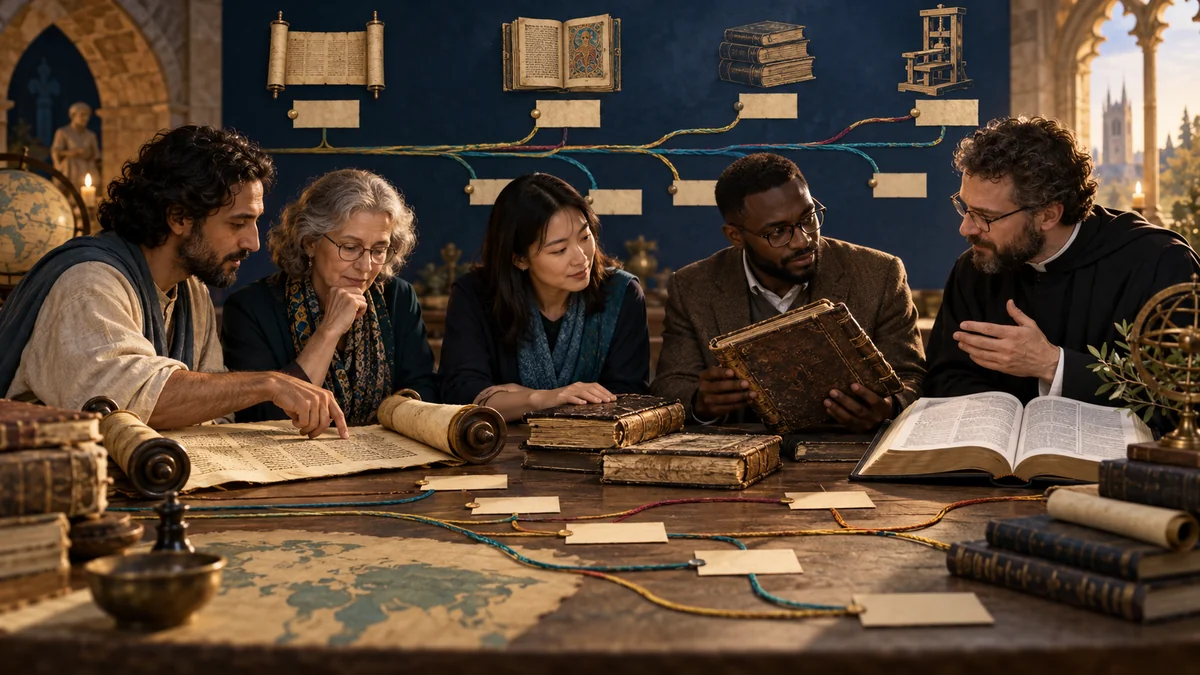
The word canon describes a recognized rule or collection. When Christians ask how the biblical canon developed, they are asking about texts, communities, worship, teaching, copying, controversy, and authority over time. The process was not simply a committee voting one afternoon, nor was it a single universal list that every community held from the beginning. Different Jewish and Christian communities received overlapping but non-identical collections, and those differences remain visible today.
This historical account need not weaken faith. It helps readers distinguish what can be established by manuscripts and early witnesses from what is a theological confession about the church’s reception of Scripture. As a Christian conviction, El Roi Digital Ministries affirms that the Holy Spirit remains the final determiner of interpretation and faithful use. This is a theological confession, not a conclusion established by a manuscript or canon list. Historical study helps us avoid claims the evidence cannot carry.
Three questions that must stay separate
What texts existed?
Ancient communities produced, copied, translated, read, and preserved many Jewish and Christian writings. Some were later included in canons; others remained respected without canonical status; others disappeared except for quotations or fragments.
Which texts were recognized?
Recognition was expressed through reading in worship, teaching, citation, lists, manuscript preservation, and claims of apostolic or prophetic authority. These signals do not always agree at every moment or location.
Why did a community recognize them?
Communities used theological and ecclesial criteria: connection to prophets or apostles, consistency with received faith, widespread use, antiquity, and perceived spiritual authority. The criteria were not applied mechanically, and later readers should not pretend that one simple formula explains every book.
Jewish Scripture and the Second Temple world
The Hebrew Bible’s books circulated in diverse textual forms before and during the Second Temple period. The Septuagint demonstrates translation and interpretation in Greek. The Dead Sea Scrolls show a rich library in which biblical manuscripts, rewritten Scripture, apocalyptic works, legal texts, prayers, and community rules existed together. The Scrolls cannot be used to prove that every text in the library had equal canonical status, but they do show why a rigid modern table of contents should not be projected backward without qualification.
The later rabbinic Jewish canon and the Christian Old Testament traditions are historically related but not identical. Christian traditions also differ in their Old Testament collections, including the books often called Deuterocanonical or Apocryphal.
For an introduction to the manuscripts and their varied contents, see the Israel Antiquities Authority’s Dead Sea Scrolls Digital Library, especially “Biblical Manuscripts” and “Non-Biblical Manuscripts.”
The New Testament collection
The four Gospels, Pauline letters, other apostolic writings, and texts such as Hebrews, James, 1 Peter, and Revelation were copied and circulated unevenly. Some churches received particular books earlier than others. The Muratorian Fragment, Irenaeus, Origen, Eusebius, Athanasius, and later Greek and Latin lists provide evidence for stages of recognition, not a single instant of closure.
Eusebius’s categories of acknowledged, disputed, and rejected writings are especially helpful because they show an ancient historian describing degrees of reception. Athanasius’s Festal Letter of 367 gives a list matching the later twenty-seven-book New Testament, but a list is evidence of recognition in a particular setting; it does not mean every congregation everywhere had the same practical collection on that date.
Why church traditions differ
The Protestant Reformation, Roman Catholic councils and decrees, Eastern Orthodox synods, Syriac traditions, and Ethiopian Orthodox Tewahedo tradition all belong to the history of canon. Their differences should be described accurately and respectfully. “The Bible” is not one physically identical volume in every Christian community. A reader should name the tradition and edition before making a numerical claim.
Avoiding two bad explanations
The first bad explanation says canon was invented by political leaders who arbitrarily removed inconvenient books. It ignores the long, distributed history of reading and reception. The second says the final table of contents dropped from heaven in a single universally recognized form. It ignores real differences, disputed books, and the work of transmission. A scholarly Christian account can affirm divine providence while acknowledging human history.
A responsible study method
When evaluating a claim about a “lost book”:
- identify the exact work and manuscript tradition;
- date the earliest evidence rather than the oldest claimed author;
- distinguish quotation, allusion, use, and canonical recognition;
- compare lists from multiple regions and centuries;
- ask how the work functioned in worship and teaching;
- identify the church tradition being described;
- consult primary texts and peer-reviewed scholarship;
- resist a dramatic conclusion when the evidence is mixed.
AI can organize canon lists or produce a timeline from verified data. It should not generate a list of “removed books” without defining canon, tradition, date, and evidence. It also should not turn a historical question into a sermon or a culture-war slogan.
Read the early witnesses in context
| Witness | Read the primary text | What this evidence establishes |
|---|---|---|
| Irenaeus, late second century | Against Heresies 3.11.8 | He argues for four Gospels. This is evidence for his fourfold Gospel conviction, not a complete Bible table of contents. |
| Origen, reported by Eusebius | Church History 6.25.3–14 | Eusebius preserves Origen’s comments on Gospel and letter reception, including uncertainty about the writer of Hebrews. Distinguish Origen’s testimony from the later historian who quotes him. |
| Eusebius, early fourth century | Church History 3.25.1–7 | He differentiates accepted, disputed, and other writings. His handling of Revelation shows that a list may preserve disagreement rather than erase it. |
| Athanasius, 367 | Festal Letter 39, sections 4–7 | Section 5 names twenty-seven New Testament books. The surrounding sections distinguish his Old Testament collection and other books for instruction. |
The Muratorian Fragment offers another useful comparison: its closing discussion distinguishes reading the Shepherd of Hermas privately from reading it publicly among prophetic or apostolic writings. See lines 73–80 in Bruce M. Metzger’s translation, The Canon of the New Testament (1987), appendix IV, pp. 305–307, available with line numbers here. The fragment’s composition date and setting are debated; its surviving manuscript and its proposed original date are different questions.
Questions readers ask
What does biblical canon mean?
A biblical canon is a collection of writings a religious community recognizes as authoritative Scripture. Canon history studies how particular communities expressed and transmitted that recognition.
Was the biblical canon chosen in one meeting?
The evidence does not support a single meeting that created one universally accepted Bible. Early witnesses describe books already in use alongside disagreements. Later church decisions belong to this history, but should be identified by their community and date.
What is important about Athanasius’s letter of 367?
Section 5 of Festal Letter 39 names the same twenty-seven writings found in the New Testament of most Christian Bibles today. Sections 4 and 7 also distinguish an Old Testament list and additional books for instruction. His letter records his own ecclesial setting, not an instant worldwide agreement.
Do the Dead Sea Scrolls prove that every preserved book was canonical?
No. The Qumran collection contains copies of works now in the Hebrew Bible as well as other religious writings. Preservation in the collection and recognition as Scripture are separate questions.
Why do different Bibles contain different books?
Jewish and Christian communities have different histories of reception and authority. Protestant, Roman Catholic, Eastern Orthodox, Syriac, and Ethiopian Orthodox Tewahedo traditions should be described in their own terms. Identify the particular tradition and edition before comparing book counts.
Does quoting a book make it Scripture?
Quotation or allusion demonstrates use. It does not, by itself, establish that every community recognized the whole work as canonical. Compare the context with explicit lists, teaching, and worship practices.
Sources and further reading
Primary texts used above
- Irenaeus. Against Heresies 3.11.8. English translation in Ante-Nicene Fathers, vol. 1, translated by Alexander Roberts and William Rambaut. Text at New Advent.
- Eusebius. Church History 3.25.1–7 and 6.25.3–14. Translated by Arthur Cushman McGiffert, Nicene and Post-Nicene Fathers, second series, vol. 1 (1890). Book III; Book VI.
- Athanasius. Festal Letter 39 (367), sections 4–7. Translated by R. Payne-Smith in Nicene and Post-Nicene Fathers, second series, vol. 4, edited by Philip Schaff and Henry Wace (1892). Text at New Advent.
- Muratorian Fragment, lines 73–80. Translated by Bruce M. Metzger in The Canon of the New Testament: Its Origin, Development, and Significance. Clarendon Press, 1987, appendix IV, pp. 305–307. Numbered translation.
- Israel Antiquities Authority. “Introduction,” Leon Levy Dead Sea Scrolls Digital Library.
Further scholarly reading
- Barton, John. Holy Writings, Sacred Text: The Canon in Early Christianity. Westminster John Knox Press, 1998.
- Lieu, Judith M., and J. W. Rogerson, eds. The Oxford Handbook of Biblical Studies. Oxford University Press, 2008. DOI: 10.1093/oxfordhb/9780199237777.001.0001.
- Gamble, Harry Y. The New Testament Canon: Its Making and Meaning. Fortress Press, 1985.
- McDonald, Lee Martin. The Biblical Canon: Its Origin, Transmission, and Authority. 3rd ed. Hendrickson, 2007.
- Ulrich, Eugene. The Dead Sea Scrolls and the Origins of the Bible. Eerdmans, 1999.
These primary witnesses document historical claims in their own settings. Further reading offers broader scholarly interpretation; it should not be treated as a substitute for the specific passages linked above.
Additional bibliography
- Charlesworth, James H., ed. The Old Testament Pseudepigrapha. 2 vols. Doubleday, 1983–1985.
- Cross, Frank Moore, and Shemaryahu Talmon, eds. Qumran and the History of the Biblical Text. Harvard University Press, 1975.
- Metzger, Bruce M. An Introduction to the Apocrypha. Oxford University Press, 1957.
- Sundberg, Albert C. The Old Testament of the Early Church. Harvard University Press, 1964.
- Ulrich, Eugene. The Biblical Qumran Scrolls: Transcriptions and Textual Variants. Brill, 2010.
- VanderKam, James C., and Peter Flint. The Meaning of the Dead Sea Scrolls: Their Significance for Understanding the Bible, Judaism, and Christianity. HarperSanFrancisco, 2002.
- Westcott, Brooke Foss. A General Survey of the History of the Canon of the New Testament. 6th ed. Macmillan, 1889. A historical account to read alongside more recent scholarship.